Showing posts with label springboards. Show all posts

Saturday, 29 December 2012

The adventurer's essentials


Every year we had make most of our Christmas gifts. My nieces and nephews are getting to an age where we can really really enjoy making stuff for them. I wanted to make a den building adventure kit for my oldest nephew. I had some ideas but I knew the Forest Education Initiative Facebook page would come up with more. They are a real source of inspiration and support for lots of people who work outdoors with children. 

I didn't use all the ideas they came up with as I would have needed a truck rather than a bag to put them all in, but check out the thread here if you would like some ideas too. 


But what's in the adventure bag?


Every adventurer needs a wind up torch...


...and some binoculars. We made these binoculars together on Christmas eve.


To go with the note book and twiggy pencil


Some flags to decorate your den,


A really wide selection of fastening; like ropes and pegs, carabiners and those really practical bungees with bobbles on the end. These are just some of the selection. 


 A really useful tarpaulin made from half of an old tent. It already had lots of zips and eyelet holes, hooks and Velcro fastening points. I added a few more eyelets to make it even more flexible and it is waterproof too, which is a bonus. I also added a piece of parachute silk which was a drogue  from a larger parachute. I added lots of eyelet holes to make good fastening points. You can also see the 'instructions' and the corner of the fleecy sit-mat I made using  a bit more of the tent as waterproof backing.


Every explorer needs a treasure map. This one was embroidered with my sewing machine. 


We made an indoor den on Christmas day and cooked the dinner on the fire...

...and we hung up this sign until dinner was ready. 

Luckily it is a  reversible sign so we could welcome people in too. 


Of course any adventurer needs a useful bag to keep all his supplies in... 


...and interesting things to discover.


Sunday, 23 October 2011

Hapa Zome (beating up leaves with hammers)

This is a wonderful creative technique that I often share with participants on training courses and with the children I work with, This week someone on a course made something so beautiful it reminded me I wanted to share this a bit more widely.

Stacey's hapa zome with clover, dandelions, grasses,
 berries and petals

Hapa Zome is the Japanese art of beating up leaves with hammers,  pounding natural pigment into cloth. It was developed and named by India Flint who is a colour artist although she suggests that people have probably been pounding colours into cloth for centuries.

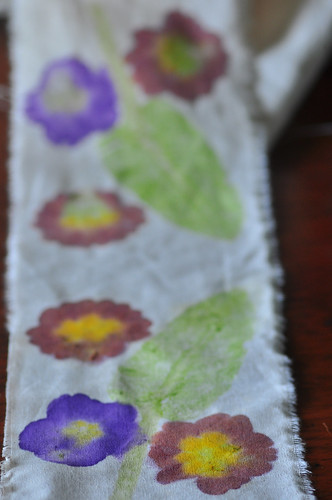
Hapa zome with dock leaves
and primula

The skill level you need to start out with this creative springboard for this is pretty basic. If you can hit things with a hammer you can create beautiful works of art. As demonstrated by a two year old and his mum.


To make hapa zome you need cotton fabric, different weights seem to all work equally well but you do get slightly different effects. The leaves and flowers that you choose make a difference to the effectiveness. Ones that are full of moisture produce the best results.
Spring crocus flowers
 By folding the cloth in half with the leaf  or petal inside you get a mirror image. Once the petal is under the cloth then it is a matter of gently pounding it with a mallet, hammer or even  smooth rock. The surface underneath will come through so find a smooth surface to work on. It seems to appeal to all ages and genders equally, I'm sure this is something to do with the cathartic nature of hitting things with hammers! 

Baby nettle leaves

Friday, 29 October 2010

I get to go indoors!!!

Being known as 'Lily who plays out for a living' has some drawbacks.....erm.... I'll tell you what they are when I think of them...
Excitingly, this winter, I will also be playing indoors too! A wonderful school has invited me into their foundation stage be their provider of springboards, their atelierista, their Lily who plays indoors sometimes too. We'll be going to the woods to do some Forest School sessions, carrying on some work we began last Spring but this will be an exciting opportunity to work over a number of terms with a group of children. Indoors and out, in the setting, in the studio, in the woods and in the grounds. 

The Foundation Stage is influenced by Reggio Emilia and I will be offering provocations and springboards and seeing where the children want to go with them. I have started to feel a bit nervous and excited! It's going to be a new challenge. But where to start? I have so many ideas for provocations I barely know where to begin. There is a part of me that is tempted to start with nothing and see where we end up.... watch this space!

Tuesday, 26 October 2010

Follow a trail through the woods

I remember back to when I first started working with children, and I remember distinctly the first group of children I ever took into the woods. We followed a trail that was marked with posts and signs and the children loved running from one signpost to another, checking that we were following the right symbols and always waaaay ahead of me.

The thing I noticed then and since, is that it takes a long time to lay a good trail or treasure hunt and then children will follow it in seconds.

I am a great believer that effort and time I put in to planning has got to a lot be less than the amount of time it absorbs others otherwise it's something I should keep as one of my own hobbies or entertainments. I remember two of my students complaining that they had spent an afternoon cutting out shapes for craft activity at an after school club and the children arrived, stuck them onto paper, bam! bam! bam!, in three seconds flat and were off to do something else.

This boils down to my default position when planning, "hmm maybe we get the children to do that bit".

So I don't ever lay anything but the simplest trails or treasure hunts for children to follow, maybe dropping a trail of feathers as I check out a site.
Collecting coloured feathers helped motivate this group
during a chilly walk and helped improve
 observational skills and awareness.

Otherwise, I see if the children want to lay the trail instead:


It helps improve empathetic skills; will someone else know this is the right way to go? How will they know which is the wrong way? How will we tell them if we are not there?


 You can split into two groups, each taking a territory and laying a trail for the other group to follow.


Have a set amount of time for each group to lay the trail and meet back at the start.


It's always good to have other things to look for along the way, animal footprints, interesting things to point out to the other group, it helps keep motivation and concentration levels up and encourages awareness of what is around.


 There are loads of different ways that you can make signs, but make sure they aren't somewhere that will get trampled.


 It can still help sometimes to swap one person from each group so at least one person knows where they should be going


Although that might just be taking the challenge out of it! Agreeing what signs mean is always helpful though.


Tuesday, 19 October 2010

A map to find the fairie's houses

If you were given a map like this one, you would have to check it out, wouldn't you? I was given this map yesterday and followed it to a special place in the woods:

Gif Created on Make A Gif


And there, in the woods, I found all the fairie's houses. Generations of them, some with little notes pinned to them, some in trees, apparently people come for miles to build houses here;


 We had been making houses of our own, for things with eyes:


Sometimes we make houses for fairies and boggarts;


They need a ladder to get into their house


The lovely andromedababe encourages people to make houses for Derek the Gnome

Do post to let us know who you make houses for...


We Play

Friday, 8 October 2010

Springboards

This post was originally on my website 26th Feb 2010. I'm enjoying being able to collect all my thoughts together in one place!
I have been thinking a lot about springboards this week. Not the swimming pool ones, but a playwork theory that was first described to me by Martin Maudesley; sometimes even if we want to stimulate free play for children, or encourage self directed learning we need to provide a solid starting point - the springboard. This then can be used by the child to take off in any direction.
I did three sessions this week taking new groups to the woods, all with three and four year olds from two different nurseries. I provided the same spring board, putting up a shelter and making smaller shelters for soft toys. I watched as each group and each child took off in different directions. On Wednesday afternoon the children found a dead bird and three boys made it the most beautiful mausoleum discussing what they thought, the emotions the bird's family and friends would be feeling and treating it very respectfully (only a little bit of poking it with a stick).
Two other boys didn't want to take part in building the little shelters until they watched an adult role modelling and then became very absorbed in making a hedgehog a home that was properly weather proof.
Their sessions then developed beyond the springboard to lots of other self-directed activity: digging, climbing, tying string, jumping off logs and carrying the biggest log as they were able.
Another group were a lot less confident and needed more direction and structure, my role became less about observing and more about providing more and more springboards, playing hide and seek, singing songs and more about setting the boundaries, as they needed these to compensate for the fact they were not as absorbed in what they were doing.
These observations have all been tied together by a discussion I had with Jen from Bradford Community Environment Project. I am writing a publication for their Wild and Safe Play Spaces Project. This is to share ideas and encourage the use of the outdoors. We have made a pact not to use the word 'activity' in the activity ideas section of the publication and encourage people to only offer a new springboard to the children when the previous one is finished with.
The finished publication can be found here:  www.kindlingplayandtraining.co.uk/page23.htm

Thursday, 7 October 2010

Building bridges

This post first appeared on my website on 28th Aug 2010
Rope Bridges
These last few months have seen an increase in the number of rope bridges I have been making with Forest school groups. It is interesting to notice how each group takes the same basic springboard and has their way of using it. 
                                  
                
With the younger nursery age children I have noticed how much more time they spend using the bridges if they have been involved in setting them up in the first place. Although having a group of helpful 3 and 4 year olds winding the ropes around trees has its own challenges, they soon get the idea and after a few times doing it they need me to tighten the ropes which they set up.
                  Setting up rope bridges 
                                Setting up rope bridges
It is really good fun pulling together to tighten the ropes, and there is always a bag of other shorter ropes to satisfy the needs of the ones who want to wind and tie ropes around themselves, the trees or my legs.
                              .   
                   
One child, who was electively mute in nursery, couldn’t resist shouting ‘look at me’ as he swung from a bridge, repeatedly dropping off to the floor and climbing back on.
 YR 5 and 6 children hadn’t been asked to queue or take turns in using the rope bridges but did it spontaneously. Crossing the bridges was part of their quest; they came up with their characters and what the bridge was built to cross. We ended up crossing rivers of fire and chocolate and a lava flow which all featured over a couple of days.
                                  
One boy in this group got the idea of how the ropes could be tied to make a bridge and was really chuffed when we used ‘his’ idea.
Building rope bridges encourages team working, problem solving and physical development; hanging, swinging, traversing etc.
                     
                               
 But it also involves a fair amount of negotiation, turn taking and fine motor development and a lot of laughing.
                    

comment FB

LinkWithin

Related Posts Plugin for WordPress, Blogger...

LinkWithin

Related Posts Plugin for WordPress, Blogger...