Showing posts with label forest school. Show all posts

Wednesday, 3 September 2014

Compound Flexibility

During my years as a Forest School leader one if the attributes that I find myself drawing on is flexibility.  Being able to change plans, put aside my agenda because of the weather, a really interesting discovery in the woods, because of something a child needs or wants to do –my flexibility is core.

The flexibility of the environment, the range and diversity of resources, how they can be used in lots of different ways. This is what feeds the success of the children. It influences their ability to manage whatever task they have set themselves. This success nurtures the child’s self esteem which in turn makes them more able to interpret their environment flexibly.  It’s a positive spiral.

 It's an idea I explored in a series of drawings for the FSA newsletter recently and wanted to delve a bit deeper into the theory here , this was first brought together by Fraser Brown’s into a theory he called Compound Flexibility; 

“This is not a simple interaction but a complex process wherein, flexibility in the
play environment leads to increased flexibility in the child. That child is then
better able to make use of the flexible environment and so on. There is massive
child development potential in a play setting.” (Brown, F. 2003, ‘Compound
Flexibility’ in “Playwork Theory and Practice, p56)


I really enjoy working in the woods as it is such a flexible environment. But what is meant by a flexible environment? Nicholson (1971) in developing his theory of loose parts, explains it like this; “In any environment both the degree of inventiveness and creativity, and the possibility of discovery, are directly proportional to the number and kind of variables in it”.  
A ‘loose part’ environment includes everything from the the branched trees of a woodland to the cones, stones, mud and twigs that lie within. Nicholson also suggests that a beach is a good example of such an environment. The sand for shaping, the sea ever changing, the rock pools whose life and form shifts with the tide. The flotsam and the jetsam. An environment full of things that fulfil many different roles and functions. A place that can be adapted to our needs and ideas.  This environment also needs the flexibility of the adults in it if children are to be allowed to explore the potential. 


This permission for exploration leads to experimentation. A wide array of elements means that children have the opportunity to combine things in different ways and find the space or material they require to fulfil the need and further the line of enquiry. Children develop by responding to a rich environment. The fewer elements there are to explore, the slower or more restricted the development. The more stimuli, the broader the development. 

One of the key factors in the compound flexibility process is that the child feels in control. This is why self-directed play is so essential for a child’s development. 


This combination of control and challenge is also what gives us good feelings! We try something, we find the resources we need to be successful. The people around us give us the time and space to work things out for ourselves which gives ownership to the success. There are things around us that suggest ideas to us. These are the perfect conditions for feeling really good about ourselves. 


These good feelings are critical to a child's development. Those good feelings mean a child is likely to take a risk and try something else. They are the sort of feelings that govern self acceptance. They are the feelings that contribute to self confidence. Good feelings will keep someone involved, interested and focused in a way no amount of cajoling, bribery or threat can manage. The child is at the centre of the process and wants to be there because it feels good. 


Self confidence also means that a child will try and solve problems when they arise. Self confidence is a desire to keep experimenting even when something goes wrong, the belief that you are able to work things out when things get tricky. This is what we often describe as resilience.  
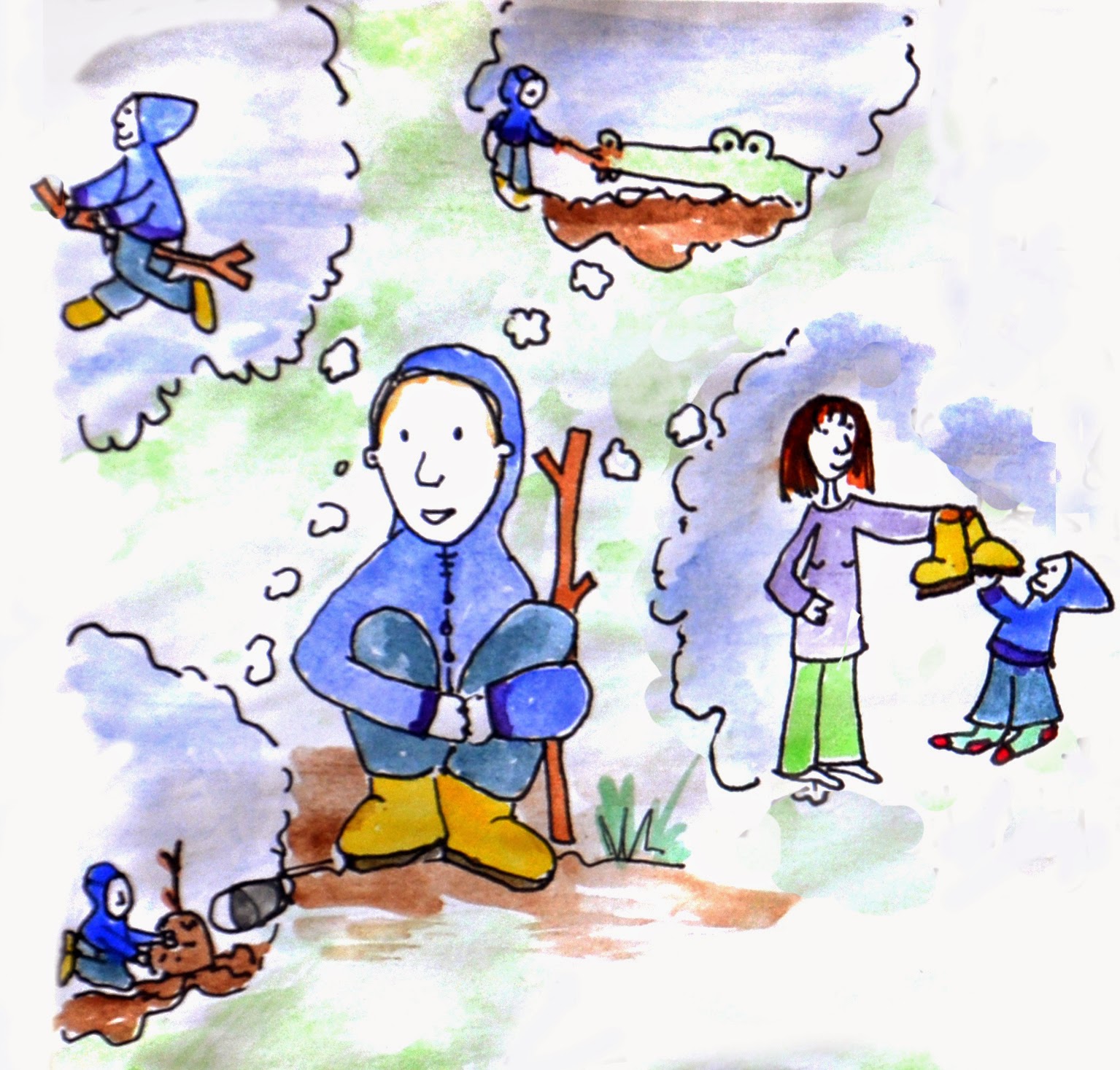

This is where the cycle connects. The exterior becomes interior and the flexibility becomes part of the child's way of being. The successful experiments suggest new ideas. The problem solving suggests a new goal.  The experience they have just encountered is added to the toolbox of the child's mind. The compounding aspect if this is that the more flexible the child is the more they see the flexibility in the environment.

Conversely a restricting attitude of the adult can shut down that extraordinary potential found in a flexible environment. The compound flexibility process can stagnate if conditions are unsuitable. Children who have little control over their world inevitably have fewer positive experiences, which in turn slows the development of their self confidence. Children who lack confidence are less likely to take risks or try out different solutions to the problems they encounter. Which makes them less flexible and responsive. 

I find that thinking about how these elements interconnect really helps me think about my role and the role of the environment that the children are in and reflect on how these two elements can combine with the child's experience to create powerful opportunities for development. 

Drawings taken from a doodle for the Forest School Association Newsletter Autumn 2014

Wednesday, 27 August 2014

Badges of honour.

Many years ago I talked with my friend Martin about the idea of the badges of honour of outdoor play. Martin wrote about this in www.playengland.org.uk/media/130593/play-naturally.pdf,  that dirt, stains and smells can be treated like ‘badges of honour’, ‘evidence of successful outdoor play’ and learning. Like all good ideas I'm still mining it. 


I recently worked in the woods with groups of children and adults as part of a summer school of transitions. Groups came to me for a full day at a time. One of my challenges was setting the expectations with staff (who were only with me for a day) around allowing the children to get immersed in activities and reinforcing with the children that it is OK to get muddy and involved. 
This is when the badges of honour turned from a metaphorical notion to a literal tangible thing. 


I filled my pockets with them and brought them out at opportune moments, a girl who raced off and find the right sorts of sticks off the den she was making, met with an 'uuuugh' from her friends as she ran through a puddle. 
A badge of honour for muddy shoes changed the story and the girls raced off together. 


A staff member complaining loudly about getting mud on her leggings actually looked kind of proud to receive the first badge of honour off the day. 

Sitting, quietly after putting a plaster on a cut, I shared with the child that he had a badge of honour too, that cuts sometimes happen because you are living life adventurously. 

As the summer holidays come to an end and looking down at my own hands and legs I can recognise there are badges of honour here too.  


Thursday, 14 August 2014

What happens after you feel the fear?

I didn't know how much of this last week would be spent dealing with fear. Heights, the dark, spiders in the toilet, bigger kids. All normal parts of a week of play in a field on the edge of a wood. But what struck me again and again is the resilience and bravery of children who know they are afraid but refuse to let that get in the way of experience. 
Jerry Hyde says there are some books which you only need to read, because it's all in the title; Feel the Fear and Do it Anyway. That sort of thing...
Choosing the forty foot tree swing, walking out in the dark, becoming so fascinated by the fact the spider has babies that you get over your fear and look through a hand lens. The tales of bravery I could tell you, and that's just one week.


It's normal to feel fear. It's part of what keeps us safe. It's part of moving out of your comfort zone. A way, as I've explored before here, to help children (or anyone) move out towards those fears that won't case harm and to still feel safe is to help them see it as a challenge and to play with the idea. You can't simply tell someone not to be afraid. Something has to replace the fear. 
We stepped out of the field, over the fence and into the dark dark woods at night. Nate said; "I'm scared!"
What of? I asked.  "Everything." replied the tiniest voice. Are you afraid of the clouds? I asked. "Yes." Are you afraid of kittens? "Yes" said a slightly bigger voice. Are you afraid of fluffy blankets? "Yes!"  ...of baby chicks?
"Yes!!" said Nate. "I want to hold Elliot's hand."
 Are you afraid of holding Elliot's hand? I asked "oh yes" Nate laughed and took Elliot's hand. 
Sometimes it's a challenge to remember why you were afraid before. 


Fear is an OK thing to feel, I tried hard to let the children know that it was OK and a normal thing for them to feel. The bodies way of dealing with fear is cortisol. The chemical trickle that, if turned into a flood will lead to a fight, a freeze or a flee. This stress response in it's trickle state gives us the adrenalised state of full attention, real curiosity and the learning sweet spot that comes with it. Too much adrenaline and the flood turns into a punch and kick, or a run from the scene. Or a shutting down, and a blacking out. Poppy's stress response is so extreme that she starts to black out if things get too noisy or busy or crowded around her. The doctors are still trying to work it out, but age 11 she manages it well, preparing an adult to take responsibility and notice the signs. Coming over and tugging a sleeve when she feels it start. Yet, the need to feel the fear and do it anyway is so strong she pleaded to be included "will I be still able to  go on the swing and the night walk even though I have my head thing? Pleeeeeeeease" she refused to let anyone suggest she was not up for it.


Clipped onto the swing and ready for her first attempt I could hear her rationalising under her breath; "my friend did it... all I have to do is is is is... if I step off here where will I go... and what if what if? So we talked about the special kind of fear that comes before you do something really cool and really safe and how that gives you an even more special kind of feeling afterwards. The feelings you have when you have overcome a challenge. "OK ready" she said and let herself go into a wild swing with a scream that could be heard across the valley. It ended in laughter. "I'm totally doing that again." 

Bob Hughes in his Taxonomy of Play Types uses the phrase; Deep Play. It's one of the hard play types to describe, yet whenever I have helped people unpack the play types and we talk about deep play, "you know that sensation when you do something tricky and you feel it right here, under your ribcage. That's deep play." Everyone nods we all know that feeling, from balancing on a wall and wobbling just a little, from climbing a tree and losing a foothold, even standing on a stage and preparing to sing or take part in a play. It's different for everyone. Your deep play could be my everyday experience. My deep play could be your relaxation. The Swedes have a saying about that feeling; occasionally you have to feel the ice in your stomach if you are to feel alive.

Sunday, 22 June 2014

Look after yourself, look after each other and look after the place we are in.

There are many ways that I have used over the years to set ground rules with children. It always boils down to this though; 


How this is works is negotiated as we need to know it, sometimes in the middle of a game we might need to stop and work out the rules and make sure they work for everyone. This process of making group agreements rather than ground rules is an important part of developing social skills and having empathy for other people's needs.


With this comes an element of responsibility for your own self. Knowing where the boundaries are and making sure you stay with the group is important. As is the ability to notice your needs and do something about them.


This can't come at the cost of the place we are in. We should remember that we are visitors, in the home of the things that live in the woods and wilds. 


I've been making some resources to help focus on these three responsibilities and I'm interested to hear how you start these sorts of conversations with the children you work with.  


Tuesday, 17 June 2014

Wood cookies swinging in the trees make romantic braids...

Occasionally I see a craft technique and think to myself "I can't wait to take that to the woods!" So it was when I attended a textile workshop with Larry Schmidt at the North House Folk School. He specialises in traditional Scandinavian textile techniques that were brought to America by the first settlers and the have wonderful names like flettet snor, frynseflet, bregdet band and rundflet snor.


I've shared this technique with various practitioners and children over the years, most recently when I was hanging out in the woods with the fabulous Treecreepers. They have done what I have never managed to do and got some excellent photos that they allowed me to share with you. (Thank you Simon and Harry).


The technique is called a Nordic slinging braid. Also known as a romantic braid because it requires two people and good cooperation!


The first step is to hang weights off four strands of wool, string or thread. These strings need to be two different colours. Wood cookies or little branch slices are ideal for weights. Treecreepers used different symbols to help people who can't distinguish the colours as easily. This promotes thinking skills, trying to work out what things would work as opposites.


The strings need to be tied together then hung above head height. This is when I realised that the woods are ideal for this. All those convenient branches! 


Next stand facing opposite each other, each with two strings of different colours, one in each hand.


The next bit is simple; take the string in your left hand and let it swing across and swap it with the string in your partners left hand. 


Now do the same with the strings held in both of your right hands.  


Now repeat; left, right, left, right and... allow the rhythm to build, the strings to swing, from one person to the next, sometimes getting faster, or slowing down, stopping completely to untangle and laugh when things go awry. 


You will notice a braid starting to develop above your head and a pattern starting to develop in the braid. This pattern will be different depending on whether you both have the same colour strings in your left hand or opposite colour strings. You could try more than two colours when you get the hang of things. 


They are called romantic braids because you can only really do them with another person, I like the way this appeals to very physical people, and people who like to get immersed in making things, as well as people who 'don't normally like this sort of thing' but think they will have a go.  


Massive thanks to Treecreepers for the use of their pictures. Check out their facebook page for more inspiration (and probably some pictures of beetles). 

Monday, 9 June 2014

Walking alongside

Sitting around the fire at a recent Forest School conference a fascinating discussion developed about the nature of the pedagogy we employ. My friend Annie, of Get Out More, remembered a conversation she and I had had a few years ago. We had been discussing the amount of knowledge that we feel we should have in order to help someone else learn. She had said to me that she had noticed something that had helped her, the realisation that you only need to be one step ahead of where the learners are. We laughed when she recalled that my answer had been "One step! As much as that?"


As I reflect on this conversation later I realise that there is a deeper truth in this idea, held in the approach to learning employed in Forest School. If we look at the word 'pedagogy' it's roots hold the secret of the skill we that we try and master, the "science and art of teaching"; 
In Ancient Greek and Roman culture the pedagogue was the adult, often a trusted slave, whose role it was to walk with the child in the street, carrying their bags and modelling how to behave in a range of situations. He or she was not the teacher who directed the acquisition of subject knowledge. The pedagogue was literally the person who walked alongside the child to the place where they learned. Maybe one step ahead, if as much as that.  


My husband and our long legged dog love to go striding out across the moors near our home. Both covering ground at great speed and exhilarating in the wild weather. I go with them sometimes but it requires careful negotiation. I have a tendency to get distracted; an abandoned egg shell from a moorland nest, a wildflower blooming in the moss, concentric circles of vivid lichens. Then, when I look up they are gone. Little specks away up the hill, (always uphill) and I have to really motivate myself to catch up. I arrive, out of breath as they wait patiently, ready to move on again.

When we try and keep pace with each other, it is much easier to get into the flow of walking. I have to walk a little faster and push myself. He has to pause and take notice of little things. The dog runs in circles around us both. But we are walking together, maybe one of us is one step ahead, if as much as that. 

This is the ideal that I try and strive for in my own practise and in the sharing of my knowledge. I try to walk alongside the children. Delighting in the observations they choose to share with me, encouraging them to push themselves a little. Rather than rushing ahead, leaving them to struggle on their own, expecting them to keep up.


The more I think about this the more I appreciate the woods as a place of playful learning. Where we can create the time and space so children and adults can learn alongside each other. That learning and developing ideas with people does not mean that we are making it up as we go along, that we are lazy or unprepared but rather we use our skills and expertise to stay with the learners. Maybe one step ahead. If as much as that. 

Wednesday, 21 May 2014

Char flowers

There is a really fascinating process you can do with fire that is basically making charcoal but without any wood...


The process of making charcoal is to get something that is carbon based; so pretty much everything that was once alive, heat it up really hot without any oxygen until the water, the volatiles and the other impurities are burnt off and only the carbon is left behind. 


So much for the science part! This is actually a lot simpler than it sounds. 

Charcoal does this with wood, but what if you used flowers and seed heads, leaves and fronds....


The best way to create an atmosphere with very little oxygen is a treacle tin, or some other metal tin with a tight fitting lid. 

This tin needs a single hole in the top. Made with a hammer and nail.


The tin then be filled with the stuff you want to char. This is the method for making char-cloth. This will catch a spark very easily and was used in tinder boxes. Leaves, flowers, seed heads and any other natural thing will also char. 


The filled tin is then put onto the fire in a hot area. This will drive anything that isn't carbon out. You will see it coming out of the hole in the top. First as white puffy clouds of smoke with lots of water in, then the smoke looks dirtier with browns and eventually blues as all the other stuff is driven out.


The next stage after this is for the objects to catch fire and we don't want that. So remove the tin and poke a twig in the top to stop any more oxygen getting in and allow the tin to cool. 

When you open it up inside are brittle black gothic versions of the things you put in. 


These holly leaves were covered in beetle blues and purples. 


We tried a dandelion head but I don't know if we were too impatient but the seeds never went really black. 


It's a really interesting experiment and everything I saw for a couple of days afterwards I wondered what it would look like. It could be an engaging line of investigation for a Forest School programme. 


Friday, 25 April 2014

‘I climbed right up to here’ or Risk and Challenge in a Forest School


Risk taking is widely understood to be a natural part of a child’s development. Adults who work with children are moving on from thinking of risk only in the context of ‘the risk assessment’ which decides those things are too dangerous to allow. But are rather looking at risk from a child’s point of view, making an analysis of the risks and the benefits to create a Risk Benefit Analysis (RBA). Risks and risk taking is even better understood when re-framed as challenges. Providing realistic challenges for children and allowing them to work through the challenges they set themselves supports their development, actively engages them and helps them better understand themselves and each other.


I am always fascinated to watch groups of children climbing trees. I remember years ago working with a little girl who was very risk averse, very challenge averse. She was part of a group of voracious tree climbers and she would watch them, anxiously reporting to the adults just how high the others were climbing. One day she stood on the lowest branch and, reaching up, tied a string on the trunk. Each week she would climb up and touch that string, until one day she felt ready to reach higher. She stood on a different branch and moved the string further up the trunk.
Recently I went out with a Forest School group who had been coming to the woods since the previous summer. They still climbed to the same height limits that we had set together months previously. But there was a change in the amount of support they required from the adults present. It had started with our active support and encouragement when they wanted to climb, more often than not we would talk them down when they climbed out of their comfort zone. This moved on to them needing our presence nearby, just in case, to the point where now they were climbing and moving around with ease. One of their classmates, who had not previously been out to the woods with us, joined in the tree climbing. Within moments had climbed higher, on different trees in a very different way, shinning up the trunk rather than climbing branch to branch, wedging himself comfortably, literally out on a limb.


Children’s responses to risk taking are as diverse as the children themselves.  Douglas & Wildavsky (1982) have suggested that there are four kinds of people when it comes to managing risk: Hierarchists, egalitarians, individualists and fatalists. Mark Gladwin (2005)1 linked these different types of risk takers to the observations he made of children at play. You may recognise these types of risk takers in the children you know and work with.
Hierachists are those people who will naturally follow the rules, who deal with risk by following the procedures. If these procedures stress safety above all then these people are unlikely to find ways to push themselves out of the comfort zone. These are the children that look to you for permission before testing themselves and conform to set parameters, like the little girl and her string.
Egalitarians have strong group identification and emphasise group solidarity at the expense of official rules. These children, like the group I was watching climb trees had developed a group norm. They had set parameters for themselves as a group and no one person in that group was likely to engage in risk taking behaviour that didn’t conform.
Individualists are independent-minded and able to defy official rules and group pressures to make their own decisions on risk management.  Like the boy who joined the tree climbing group but went out on a limb, individualist children are the likeliest to engage in risk-taking of the kind described by Hughes (2001) as “deep play”.
Fatalists are those people who submit passively to external control without commitment to group norms or solidarity and take no steps to either avoid risk or manage it.  These children are the hardest to predict how they will respond to a risky situation. I wonder if their response to risk is borne out of inexperience in risky situations. Sue Palmer (Toxic Childhood 2006) says “All real children’s play involves an element of risk, and the more real play children are allowed the better they become at analyzing and managing those risks. If, on the other hand, adults try to eliminate risk from their lives they’re likely to grow up either unduly reckless or hopelessly timid.”

By observing the children we work with and understanding their approach, our response to their risk taking can become more informed. The risks we all take as humans take are not only physical but are social and emotional.  Forest School gives lots of opportunities for risk taking and challenge. For some children just being in woodland, especially if it this is an unfamiliar environment, is an emotional challenge. The opportunity to climb, move tree trunks, run on rough terrain etc provides endless physical challenges. Using tools and being around fire provides opportunity for physical and emotional challenges for children. Being in a group without the structure of a classroom and having to communicate with others, talking with a partner when using a saw to cut wood provides social, physical and emotional challenges. When someone overcomes a challenge, be it one that is set by ourselves or by others and we are given chance to reflect on how we feel, we offer the opportunity to build those critical qualities of self worth and resilience.


It is too easy under the guise of health and safety to try and remove the risks and therefore take away any challenge in the activity or environment for the children and it is worth noting that the child’s need for having a challenge, if not met, will often express itself in other ways including what we call ‘challenging behaviour’. The importance of a Forest school activity is in providing children the opportunity to take risks and build their self-confidence.

 “Most psychiatrists agree that mental health in adulthood springs from a successful weaning of the child from its parents, an ability to deal with the outside world confidently, without overdue dependence on adults. And making good relationships can only come with practice. Through unstructured play with others, children can work through their emotions and discover their identity.
If they are never free from adult supervision, they cannot internalise a parental voice or find a way of setting their own boundaries. They have no chance to do mildly dangerous things and find out how risks should be judged. They cannot chart their own course through the minor hazards of everyday life. Nor can they explore the real bonds of friendship and loyalty that are formed through common adventures with others their own age.”
(Sieghart, M. A. in the Times, 5 th August 1995)

References:

Playwords (Summer 2005 - Issue 26)

*This post, written by Lily, was originally published on Outdoor Play and Learning.com  in March 2011 and is republished here with their kind permission. 

Wednesday, 2 April 2014

Oak Apple Ink

There is something about playing in the woods, exploring, experimenting that really stimulates discoveries.
I remember when I was a teenager reading about oak gall ink in a book on art techniques but I hadn't tried it until today.

Oak galls are fascinating little discoveries in themselves. Found on the underside of oak leaves the are created when a teeny parasitic gall wasp lays an egg on the leaf bud. The interaction between the leaf and the egg as they grow creates a gall, a little ball in which the wasp larvae can grow and eventually it burrows out and flies free.


The wasps emerge in the autumn leaving the galls behind. Last week, I picked one off the forest floor and as I was chatting with someone about what it was I gave it a squeeze and brown water came out.

There are lots of recipes available on-line which involve grinding oak apples and adding iron but this water, just freshly squeezed, made me wonder if this would work as an ink. The oak is really high in tannins and it stains really well.

I got a feather and snipped it into a quill and it worked perfectly. Instant ink to be harvested from the woods.

Monday, 6 January 2014

Maslow’s hierarchy of need or why, in winter, we always have hot chocolate..

I was just repacking and checking through the safety bag that I take into the woods with me and I felt like something was missing. There had been a lot more space in the bag over the summer but as the weather changes so does the contents of my safety bag.  So I added another bag, full of small gloves, hats and scarves. There is a well known saying that there is no such thing as bad weather, just the wrong clothes, but it is hard to really feel the full impact of that saying until you see a child, he isn’t engaging with the woods around him, but is stood, hunched, with his hands tucked under his armpits, watching the others.  “Would you like some gloves?” He nods, chooses a pair and runs off to join in. True, it is another thing for me to carry, but the difference it can make to a child’s ability to join in is worth it. I hope most children come prepared to play and learn outdoors but the reality is often they don’t. I think that part of my role as a Forest School practitioner is to try and remove any barriers that stop someone from being able to enter fully into learning, exploring and being in the woods. 


Forest Schools are a place where children can develop self confidence and self esteem and we aim for children to be accessing deep level learning experiences, where they are immersed and in the flow. But like that little boy, people can’t access that powerful, playful learning state if their hands are cold.  The Hierarchy of Needs, as in the theory put forward by Maslow, and extended in this diagram by the Australian child psychologist Louise Porter makes it clear as to why.


Porter describes how after survival and emotional safety, children look for belonging (connectedness, empathy, acceptance) and autonomy (choice, mastery, self-efficacy). Belonging is connected to fun, and autonomy to self-fulfilment. But critically the survival needs; warmth, shelter, food and drink; are at the root of all progress towards self actualisation. If we are concerned or distracted by those needs, we cannot focus on our self-fulfilment or on having fun.  
Children, even quite small children want to look after their own basic needs, they need to know what resources are available, how to use them and have the confidence in you to want to ask for them.  The process of meeting those basic needs can be a vehicle for having fun and feeling proud of your achievements. If you have ever put a temporary shelter with a group of children you soon learn there is lots of fun to be had, shaking the tarpaulin, rolling and wrapping yourself up in it, winding the strings around trees, running through a tunnel like half built shelter. Then, the fleeting moment of pride and satisfaction when the shelter is up and we are ready to get stuck in to our adventures.
For children to be given the language and opportunity to name their needs, and be given the resources to meet those needs is also very important. This little doodle that went into the recent Forest School Association newsletter explores this idea in reality; 


I have noticed that the amount of effort and the designs that children organically come up with for their shelters reflects the weather and their needs. A group of three and four year olds on a snowy morning made a shelter that wrapped them all up, cocoon like inside, protected on all sides. No room for any adults in there though, apart from just enough space to pass in mugs of hot chocolate. On the same afternoon, when the sun had come out and the snow was melting a group of their classmates made a shelter that was entirely different, much more open and spacious, no need to huddle together for warmth any more.

That is why as the weather turns I am checking the supplies of hot chocolate, rinsing out the flask and packing the little gloves into my Forest School safety bag.

*This post, written by Lily, was originally published on forestschools.com in Jan 2011 and is republished here with their kind permission. 

Tuesday, 26 November 2013

Child led learning or how it feels to not be in charge

Giving control over content and intent of play and learning to children

Child-led learning sounds like it should be easy, just see what the children are interested in and excited by and then follow it. Actually, when you put it like that it is easy and in the context of outdoor learning  allowing the children to lead can be wonderfully simple to implement. There is so much to discover and interact with. It is hard NOT to be learning.  Where child led learning becomes more challenging is in the personal internal battles you face as a practitioner.

I am thinking for example about a time when a group of children decided they would have a ‘bug market’ where they could trade things with each other. They decided they could bring things from home, or trade conkers, interesting leaves and other found natural things.  They asked us to provide materials for signs, sheets to set things out on and they left the session really excited about the upcoming Bug Market.

It was only after they left that we started to realise the gaps we had left open, what sort of things would they bring from home? What were the ethics of trading live insects? Who would decide what trade was fair? How would we agree the rules?
One of the key lessons I have learnt over the years is to never imagine that I am in charge. It can be a real challenge to master my ego, not listen to the voice that says “Well, I know best because I am an adult.”  Or allow the part of me that already sees how this could go horribly wrong to be too dominant. 


When the children arrived for the Bug Market it seemed that the children had all understood what the rules were to be without me having to get them into a discussion. No-one brought their favourite toys to swap, you don’t have insects in a bug market, (and apparently I should have know this!) and the adult role seemed to be to keep currency moving around as more people wanted to be stall holders than to barter. 


But child led learning doesn't start the moment you decide to step back. When I walked into a woodland with a group of nursery children, most of whom had never been in a woodland before, it’s almost like they couldn't see the potential, and didn't know yet how to interact with it. It took a few sessions of going back to those same woods, with practitioners and staff providing encouragement and permission to the children to collect things they saw, asking them to describe their finds and to interact with them, to follow trails of feathers and touch mossy stumps and smooth leaves. Then the children started to notice and to lead. A long worm stopped us in our tracks as we walked up the path. The children are acutely observant, “it is coming towards me,” “now it is going to you,” “it is a letter C for Callum” “it feels sticky, like a fish” They put things in its path to see if that changes the direction it goes in.

When, during the following session we brought magnifying glasses and pictures of the minibeasts they could find they responded really positively and were quickly immersed and interested. Child-led learning can take time to emerge, as group dynamics settle and the children gain the confidence to lead and to believe their ideas will be listened to.  This is one of the reasons why effective outdoor learning takes place over time.


They start to see your role as a provider of resources, ideas, ways and means rather than the instructor, which can often run counter to the normal relationships they have with teachers and other adults.
The natural environment is an unpredictable place, you never know what you will find. You can plan and prepare for certain learning experiences to take place, and they may happen, but what you cannot plan for and only be receptive to, is the unexpected.


"In preparing for battle, I have always found that plans are useless, but planning is indispensable."
–General Dwight D. Eisenhower


Sometimes like with the Bug Market, the children are explicit about the direction they want to take, sometimes child-led learning comes about by following a particular line of questioning and sometimes an observation is the key. In the first week in the woods with another group, William picks up a sharp stone and uses it like a tool; another child watches him and copies, using a stick with the same motion. It occurs to me they are whittling. Even though I don’t usually bring tools in this soon, their behaviour intrigues me and I bring potato peelers for them to whittle with for the next session. 


Outdoor play and outdoor learning provide enough scope for each child to be following his or her own line of enquiry and for them to collaborate with other children and adults. But those internal battles I mentioned... how do you feel about how you are perceived in your role? Not by the children, but by other practitioners, visitors, parents and parent helpers, a passing head teacher or an Ofsted inspector. What happens when the lines of enquiry that the children choose to follow includes squishing living things, making weapons, having battles....? 

*This post, written by Lily, was originally published on forestschools.com in Oct 2010 and is republished here with their kind permission. 

comment FB

LinkWithin

Related Posts Plugin for WordPress, Blogger...

LinkWithin

Related Posts Plugin for WordPress, Blogger...