Thursday, 5 April 2012

Nature transforms an egg..... or how to make green eggs.

This is one of those things that I have been wanting to try for a while. I was invited to join a school's  staff Easter egg decorating competition. So I took the opportunity to dye some eggs using natural materials.


In my mind, I would have time to transform the eggs into an entire forest complete with kids climbing little wooden trunks that i would carve for the eggs (I am working on a Forest school project at the school). In reality I was delivering a training course all week that meant I didn't even have time to get to the post office let alone carve wooden tree trunks etc etc... 

But this does mean I have made an Easter craft, early enough to post a blog about it in time for other people to do the same thing for this Easter. I had so much fun researching and experimenting and I hope you are tempted to have a go too.

I wanted a leafy effect on the eggs, looking around the kitchen for something I could use as a leaf shape (without going into the garden with a torch) I thought coriander leaves would work perfectly. My herbs are a great source of indoor leafage, which is why my bow drill fire lighting set smells vaguely of basil!

The leaves stuck to the eggs best when they were both slightly damp, then some bits of old stocking were bound around the egg with elastic bands to keep the leaves in place.


My first experiment was with onion skins from white onions. I managed to get enough skins by raiding the onion display at the supermarket and filling a bag full. I chose pale coloured eggs too, (it was a this point that my partner decided he would go and do the rest of the shopping and leave me to raiding onions skins and swapping eggs in the boxes to get all pale coloured ones) 


I boiled the skins until the colour got quite strong. Then I added a splash of white vinegar and the eggs and boiled them for ten minutes. My reasoning was if it didn't work then we could still eat the eggs. 


They worked beautifully  though. They remind me of the patterns you get from sun print paper or cyanotypes. This whetted my appetite for more experimentation. I tried red cabbage next, boiling the cabbage until the water became strongly coloured then adding the eggs and vinegar. I'm not sure if the vinegar is entirely unnecessary, It makes a good acid environment and i know from working with natural dyes on cloth that some natural dyes work well in an acid environment and it seemed to work the first time so I added a splash to this batch too. 


After 10 minutes the eggs didn't seem to have changed colour so I just left them in there. Fixing the leaves and the tights onto the eggs was quite fiddly so I didn't mind the time until the next batch. After quite a long time, maybe 35-40 minutes (and regular checks) the blue colour had finally struck! It was worth waiting for as the beautiful blue reminded me of robin or blackbird eggs. The colour didn't seem quite as 'robust as the brown and I had to be careful handling these as the colour seemed to rub off, this wasn't the case when they were fully cooled so it seems almost like the colour has to set. 


But for my idea for the competition I really wanted green. Trees are green, so my eggs should be green. And also I had two lovely pans full of stinky sludge, one that made blue and one that made yellowy brown. I know if I had been doing this with a group of kids that they would have started mixing up concoctions and I can't fault a good concoction. I added the two pans together, lobbed in a bit of stale tumeric for good measure and boiled the eggs in it for a good half hour. It smelt pretty strong ( a bit like cooking up chutney) and seethed in a satisfying way that suggests this is one of those crafts that would appeal to children who like making putrid potions and yet would produce something that would please their mums! 


It did produce a green, but a sort of light sagey slightly sludgey green which was good enough for me. Before I ran out of eggs I tried some in the water that comes with beetroot but that didn't seem strong enough. But if you want to experiment I found this list of suggested natural things to dye eggs with on http://chemistry.about.com/od/holidayhowtos/a/eastereggdyes.htm

LavenderSmall Quantity of Purple Grape Juice
Violet Blossoms plus 2 tsp Lemon Juice
Red Zinger Tea
Violet BlueViolet Blossoms
Small Quantity of Red Onions Skins (boiled)
Hibiscus Tea
Red Wine
BlueCanned Blueberries
Red Cabbage Leaves (boiled)
Purple Grape Juice
GreenSpinach Leaves (boiled)
Liquid Chlorophyll
Greenish YellowYellow Delicious Apple Peels (boiled)
YellowOrange or Lemon Peels (boiled)
Carrot Tops (boiled)
Celery Seed (boiled)
Ground Cumin (boiled)
Ground Turmeric (boiled)
Chamomile Tea
Green Tea
Golden BrownDill Seeds
BrownStrong Coffee
Instant Coffee
Black Walnut Shells (boiled)
Black Tea
OrangeYellow Onion Skins (boiled)
Cooked Carrots
Chili Powder
Paprika
PinkBeetroot
Cranberries or Juice
Raspberries
Red Grape Juice
Juice from Pickled Beets
RedLots of Red Onions Skins (boiled)
Canned Cherries with Juice
Pomegranate Juice
Raspberries


I could have carried on experimenting for longer but I had run out of eggs. I rubbed a little bit of cooking oil onto the shells to make them shiny and they are looking very festive in a bowl on my table. I never did get them to the competition. 

Saturday, 25 February 2012

Comfort-Challenge-Fear

"So, what makes you feel comfortable?"
This was the question I asked a group of seven to nine year olds this week. We were in the woods for the first session of our Forest School sessions and I wanted to help focus them on what they would be doing over the next few weeks. Their answers were the sort of this you would expect, sitting on the sofa, laying in bed, being wrapped up in a cozy blanket. We feel comfortable when we are doing things that are easy and we have done them before. But that isn't why children take part in Forest Schools.


Forest School programmes are about more than spending time in the woods and exploring. They are also about encouraging children's motivation and helping to develop positive attitudes, stretching the children and helping them realise their skills. These things just don't happen when you stay in your comfort zone.

Challenge: moving out of your comfort zone
 but still being able to function
This was how I explained to the group; we would be coming to the woods for Forest School and this is to challenge them, to try new things and for them to find out things they didn't know they could do. It is important for the children to be challenged but at the same time making sure they don't feel pushed too far.


I've been thinking about this model for a while, it is in common parlance in adventure activity circles and leadership management but I don't normally share this sort of thinking directly with the children. I was talking with a friend Kirsty who is a youthworker about how she shares models like this with the young people and this is so simple I knew the seven to nine year olds could get it too. So we laid out the different elements and talked about how important it is to move out of your comfort zone. They got it straight away and I saw lots of self motivated behaviour.


Comfort zones are such a personal individual thing and this is where the most important challenge for these children will come from. The challenge they set themselves.


Friday, 17 February 2012

Let ME play!

Last week a series of posters were doing the rounds, originated from Explorations Early Learning: http://www.explorationsearlylearning.com/shop5/posters.html

This one really caught the imagination of a number of people on facebook:


It's great isn't it! It speaks to that part of us that knows that young children need to play and explore, it shows a boy engaged with his world. It also spoke to the adult who still feels like this. 

Because yes, there are still adults who feel like this.


All kudos must be given to Marc Armitage http://www.marc-armitage.eu/ who started the idea of remaking the poster for yourself and the other play and Early Years professionals who joined in. http://www.facebook.com/media/set/?set=a.280106425388257.66030.100001667062153&type=3

I love the idea that adults still see themselves as playful beings. How do you play?

Sunday, 12 February 2012

Yes, and... Play and learning.

Sometimes I feel like describing ‘play’ is like drawing the wind. You can recognise it, you know what it looks and feels like, but it is somehow nebulous and hard to pin down. I have been working in the field of play and playwork for nearly fifteen years and yet I have still to find just one way to describe what play is. I love the fact that all you need is a handful of playworkers (and maybe a bottle of something) and ask, “What is play?” and they’ll be at it for hours!


A few weeks ago My friend Kirsty and I delivered a workshop for the Institute of Outdoor Learning on playfulness and flow states. We were exploring how an understanding of theories can help learners in a range of environments Looking for 

"Play' is a term employed in psychology and ethology to describe to a range of voluntary, intrinsically motivated activities normally associated with recreational pleasure and enjoyment”1


Which sums up the feeling we were trying to convey through our workshop, that children and young people get so much out of being able to direct their activities into something that holds their involvement, that it is important for children and adults too to be allowed to play. In recent years I have been doing more work in formal learning environments and I really see the value of the spirit of playfulness I bring to the work I do. The aspect of play or playfulness that really appeals to me, especially when I was considering how it motivates and engages learners, is the state of immersion and engagement that a child at play can enter, when the real world is lost to them and they understand totally what the rules are. Even if there are other agendas that the teachers or facilitators are trying to manage, there are still benefits to following the children into that zone, that place of immersion.


I heard a comedian talking about improvisational comedy and  he was saying how improv can be made to work if the people taking part in it follow the rule of “Yes! and....” basically, if you take whatever is offered and try to build on then you get to a more interesting, and in their case funny and surreal, place. That really strikes a chord! I know from my own teaching, training and playing that when something comes up from the group you have two choices, one is to try and shut it down and bring people back. The other is to accept what is offered, “Yes! and....” to go with the new direction. Let things come back to the starting point naturally and allow people feel more included and involved with what they are learning. Even when there is a very specific outcome you can still get to the same end point by following the meanders that include other people’s ideas rather than sticking only with your own route.

Playfulness for me is about being responsive and flexible, embracing the unpredictable nature of the world and the people in it. What do play and playfulness mean to you? 

Sunday, 23 October 2011

Hapa Zome (beating up leaves with hammers)

This is a wonderful creative technique that I often share with participants on training courses and with the children I work with, This week someone on a course made something so beautiful it reminded me I wanted to share this a bit more widely.

Stacey's hapa zome with clover, dandelions, grasses,
 berries and petals

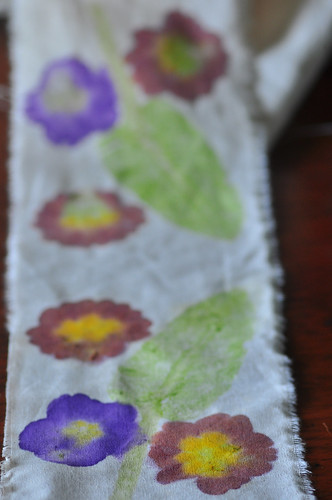
Hapa Zome is the Japanese art of beating up leaves with hammers,  pounding natural pigment into cloth. It was developed and named by India Flint who is a colour artist although she suggests that people have probably been pounding colours into cloth for centuries.

Hapa zome with dock leaves
and primula

The skill level you need to start out with this creative springboard for this is pretty basic. If you can hit things with a hammer you can create beautiful works of art. As demonstrated by a two year old and his mum.


To make hapa zome you need cotton fabric, different weights seem to all work equally well but you do get slightly different effects. The leaves and flowers that you choose make a difference to the effectiveness. Ones that are full of moisture produce the best results.
Spring crocus flowers
 By folding the cloth in half with the leaf  or petal inside you get a mirror image. Once the petal is under the cloth then it is a matter of gently pounding it with a mallet, hammer or even  smooth rock. The surface underneath will come through so find a smooth surface to work on. It seems to appeal to all ages and genders equally, I'm sure this is something to do with the cathartic nature of hitting things with hammers! 

Baby nettle leaves

comment FB

LinkWithin

Related Posts Plugin for WordPress, Blogger...

LinkWithin

Related Posts Plugin for WordPress, Blogger...