

Showing posts with label nature. Show all posts
Showing posts with label nature. Show all posts
Sunday, 15 June 2014

Wednesday, 21 May 2014
Char flowers
There is a really fascinating process you can do with fire that is basically making charcoal but without any wood...


The process of making charcoal is to get something that is carbon based; so pretty much everything that was once alive, heat it up really hot without any oxygen until the water, the volatiles and the other impurities are burnt off and only the carbon is left behind.
So much for the science part! This is actually a lot simpler than it sounds.
Charcoal does this with wood, but what if you used flowers and seed heads, leaves and fronds....
The best way to create an atmosphere with very little oxygen is a treacle tin, or some other metal tin with a tight fitting lid.
This tin needs a single hole in the top. Made with a hammer and nail.
The tin then be filled with the stuff you want to char. This is the method for making char-cloth. This will catch a spark very easily and was used in tinder boxes. Leaves, flowers, seed heads and any other natural thing will also char.
The filled tin is then put onto the fire in a hot area. This will drive anything that isn't carbon out. You will see it coming out of the hole in the top. First as white puffy clouds of smoke with lots of water in, then the smoke looks dirtier with browns and eventually blues as all the other stuff is driven out.
The next stage after this is for the objects to catch fire and we don't want that. So remove the tin and poke a twig in the top to stop any more oxygen getting in and allow the tin to cool.
When you open it up inside are brittle black gothic versions of the things you put in.
These holly leaves were covered in beetle blues and purples.
We tried a dandelion head but I don't know if we were too impatient but the seeds never went really black.
It's a really interesting experiment and everything I saw for a couple of days afterwards I wondered what it would look like. It could be an engaging line of investigation for a Forest School programme.
Wednesday, 2 April 2014
Oak Apple Ink
There is something about playing in the woods, exploring, experimenting that really stimulates discoveries.
I remember when I was a teenager reading about oak gall ink in a book on art techniques but I hadn't tried it until today.
Oak galls are fascinating little discoveries in themselves. Found on the underside of oak leaves the are created when a teeny parasitic gall wasp lays an egg on the leaf bud. The interaction between the leaf and the egg as they grow creates a gall, a little ball in which the wasp larvae can grow and eventually it burrows out and flies free.

The wasps emerge in the autumn leaving the galls behind. Last week, I picked one off the forest floor and as I was chatting with someone about what it was I gave it a squeeze and brown water came out.
There are lots of recipes available on-line which involve grinding oak apples and adding iron but this water, just freshly squeezed, made me wonder if this would work as an ink. The oak is really high in tannins and it stains really well.
I got a feather and snipped it into a quill and it worked perfectly. Instant ink to be harvested from the woods.

I remember when I was a teenager reading about oak gall ink in a book on art techniques but I hadn't tried it until today.
Oak galls are fascinating little discoveries in themselves. Found on the underside of oak leaves the are created when a teeny parasitic gall wasp lays an egg on the leaf bud. The interaction between the leaf and the egg as they grow creates a gall, a little ball in which the wasp larvae can grow and eventually it burrows out and flies free.
The wasps emerge in the autumn leaving the galls behind. Last week, I picked one off the forest floor and as I was chatting with someone about what it was I gave it a squeeze and brown water came out.
There are lots of recipes available on-line which involve grinding oak apples and adding iron but this water, just freshly squeezed, made me wonder if this would work as an ink. The oak is really high in tannins and it stains really well.
I got a feather and snipped it into a quill and it worked perfectly. Instant ink to be harvested from the woods.
Sunday, 17 November 2013
Only made from wood; a daily advent of festive winter crafts part 2
Last year I set myself a creative challenge over on my facebook page. Every day in December so far I added a new winter festive craft made from things from the woods to a folder full of photographs. Well, now the nights are drawing in again I thought I'd collect some more ideas up for you.


A really simple one this; cutting slices from logs then
sanding them smooth is something I have done lots of times with groups of
children. We have used them for medals or name tags or tokens. Here I used a
pyrography tool to make a little robin decoration.

This is such a great idea and uses another small wood
slice. I picked up this idea from
Magaret. It's really quick and simple to make, but there are lots of ways you
could decorate the base or the tree. The fir twig has just been trimmed a
little to make it more 'tree' shaped.

As this time of year is the time for freezing weather it
inspires lots of ice sculpture posts across the pages I folllow. I really love
the combination of ice and fire. Putting one pot inside another as they freeze
makes these beautiful candle holders that would be perfect for an outdoor
winter party.

These reindeer are lovely to make, with drilled logs and bits of twig to connect them together they can be in lots of different sizes. This little fella even has a red rosehip nose.

This idea was shared with me by Kelly from Alcester nursery,
what a fantastic idea! I'm always surprised by how many green leaves are still on the trees in winter, they have been threaded onto a skewer with an elder bead trunk.

I was in the woods when I noticed
the honeysuckle plants winding around themselves. I have really come to love this plant
for its pliable stems. I added a few stars snipped out from leaves, which is an
idea I developed when I got home using different shades of birch bark.
Part 1 of this round up of crafts is here. I'd love to see what you are making.
Sunday, 9 December 2012
Only made from wood; a daily advent of festive winter crafts part 1
I have set myself a creative challenge over on my facebook page. Every day in December so far I have added a new winter festive craft made from things from the woods to a folder full of photographs.
.jpg)


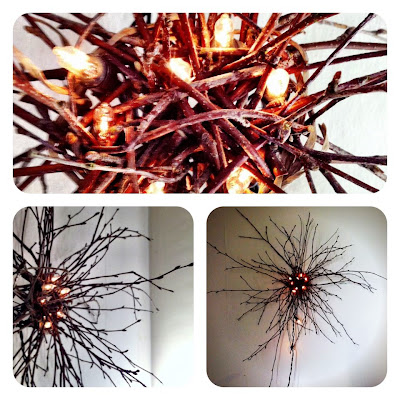


Here's a round up of my daily ideas so far.
I got this lovely idea for a tree made from threaded sticks from 'Michelle made me' this is now hanging in my office and looks great!

I learnt to make stars from bendy willow withies a few years back, I saw Alan from Birch Forest School make some of these stars from bramble which works really well and helps clear some of the bramble from the woods. I love making baskets out of bramble and it weaves really well as these stars show.

I saw this idea for a Christmas tree on Handmade Living Frugally and I really wanted to try it this year. It looks really effective and doesn't fill my living room! I also love that it acts like little shelves for some of my favourite things like the little wooden horse and some of the keys I got in a recent freecycle triumph.

I've been making little versions of these gnomes with different colours, These festive ones have just gone to live in a school where I was working last week. I found it was much easier for children to carve if you leave the stick longer and cut it to length after the whittling is done. Inspiration for these came from GardenMama.

When I made the two trees above I was left with lots of the really fine birch twigs. When they are fresh they are so bendy and I we playing with a pile of them. They are twiddled together to hold this decoration in place. The random weaving is strong enough that I could poke fairy lights through from the back.

Here is one of the decorations from my tree, this is made out of woven birch bark. There are some great tutorials out there, they are quite fiddly to make but so worth it. Look out for fallen birch trees to take the bark from.

I managed to get other people involved in my advent challenge. Hannah was one of the participants on my most recent Level 3 Forest School training course. She was exploring the potential of the woods for creativity and found that dead bracken makes an excellent base for wreaths.

This is another skill I teach on the Forest School course, lashing and knot tying. For smaller children I sometimes give them elastic bands to hold sticks together with instead of tying knots. These stars do look great with a bit of extra festive foliage.

There was a thread about festive ideas on the FEI facebook page recently where I read the phrase 'elder candles' I found some red bramble leaves which inspired me to have a go at trying to work out what an elder candle would look like. The leaves stuck into the soft pith of the elder and with some of the bark peeled away they look quite effective. You could press the leaves to make them last longer.
I hope some of these ideas have inspired you to have a go at making something this winter. Look out for the next few advent crafts coming up.
Thursday, 11 October 2012
Reflections on moving from survival to thrival
I have recently come back from a month long trip deep into the wilderness in NW Ontario, Canada. Which almost explains how quiet I have been here recently. It has been a lot to process.
I have talked before about how I the work I do encourages children to challenge themselves and as an adult who supports that then I should be doing the same. But this trip was more than personal challenge (although there were days like that) It was an opportunity to deeply immerse ourselves in nature, to take things at our own pace for weeks at a time and to adjust our rhythms to those of the world rather than the clock.
My partner and I packed three weeks worth of food into our packs, travelled to a remote little outfitting town just north of the Quetico Wilderness Park where we picked up a canoe and then quietly slipped off into the woods and lakes for three weeks paddling, portaging and a change of pace. It's the second time we have been to the boundary waters wilderness and with over a million acres of lakes and forest with no roads or houses, there is a lot to take in.
This trip was different though, I was trying to explain it to a friend and said "we moved from survival to thrival" I had made up a new word, I admit it. But that sense of moving from just coping and surviving to something greater, I needed a word that described a concept just right. As with all the best things I found that someone else had also come to the same realisation.
One of the key things for me that felt different was our desire to create and how much time we gave to making things. Carving a sculpture from an interesting bit of firewood, making a spoon from a beaver felled greenwood branch, baking... lots of baking, fresh bread and cake every few days and firing our own pottery.
We had been told to watch out for one particular trail between two lakes as it was deep clay and it becomes very difficult to walk across if it has been raining. Inspired by sculptures we had seen in the Museum of Inuit Art in Toronto the thought of a cache of deep clay lured us in that direction.
I have read quite a lot about pit kiln firing and tried a few experiments but we didn't want to make the impact in the environment of digging a pit. So we gradually heated the dried clay things by the fire, bringing them closer and closer to the ember bed, then putting them in the embers. This took about half and hour.

I have talked before about how I the work I do encourages children to challenge themselves and as an adult who supports that then I should be doing the same. But this trip was more than personal challenge (although there were days like that) It was an opportunity to deeply immerse ourselves in nature, to take things at our own pace for weeks at a time and to adjust our rhythms to those of the world rather than the clock.
 |
| Sunrise from our camp on West bay. Photo Tim Rowe |
 |
| The view from under the canoe, walking a portage trail between two lakes. Photo Tim Rowe |
 |
| Early morning paddling. My partner makes these paddles. |
One of the key things for me that felt different was our desire to create and how much time we gave to making things. Carving a sculpture from an interesting bit of firewood, making a spoon from a beaver felled greenwood branch, baking... lots of baking, fresh bread and cake every few days and firing our own pottery.
 |
| Carving a spoon |
We had been told to watch out for one particular trail between two lakes as it was deep clay and it becomes very difficult to walk across if it has been raining. Inspired by sculptures we had seen in the Museum of Inuit Art in Toronto the thought of a cache of deep clay lured us in that direction.
 |
| Digging clay from the side of a trail |
 |
| Shaping the clay |
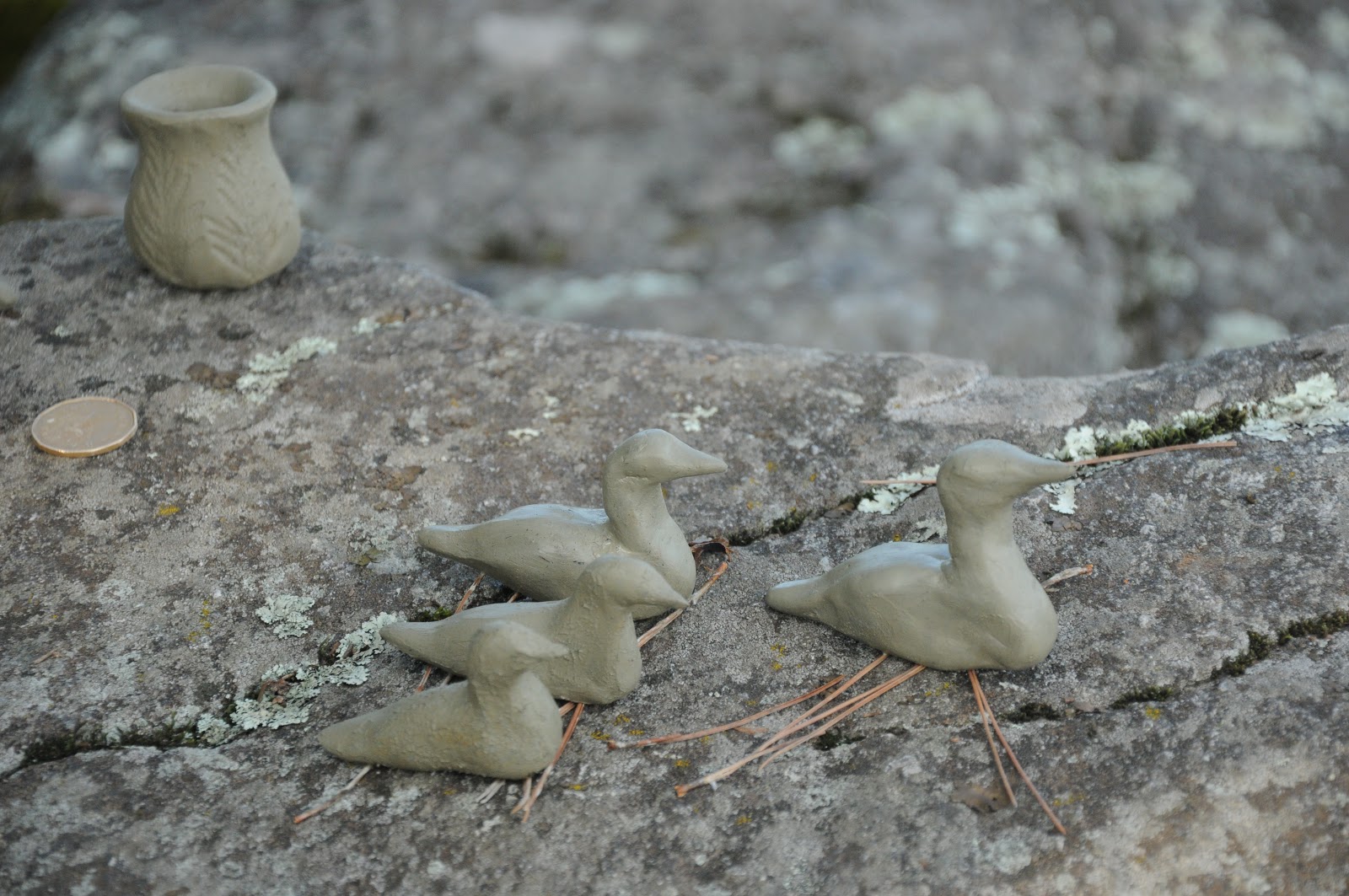 |
| These birds were based on the loons that were often found swimming around us on the lakes |

First we added fine twigs and pine needles to the embers to bring the level of heat and cover the clay things, adding bigger and bigger twigs until they were covered and a small fire was burning.
We added larger pine, birch and conifer twigs until the fire burned really hot. This took another half hour or so and even though the temptation and the heat was unbearable we kept the fire burning at a high temperature for another half an hour. We could see everything glowing red in the fire. Despite wanting to peek we let everything cool down slowly before raking the coals aside to reveal our hoard.
When Maslow talks about creativity he talks about self actualisation; "the full use and exploitation of talents, capacities, potentialities" and that these emerge when physiological and safety needs are met. Having experienced the environment and challenge once we were able to find new potentialities in that environment and in ourselves.
Through our experience of thrival I feel like I have managed to empty all the accumulated clutter or everyday experience, strip things back a bit, get a bit of the rawness back in, push myself, to laugh when I have been dragging a canoe all day through an impassable swamp that looks like a river on the map, enjoy, immerse in nature and take time to be. Oh yes that's why I do it.
 |
| Uncovering the fired clay |
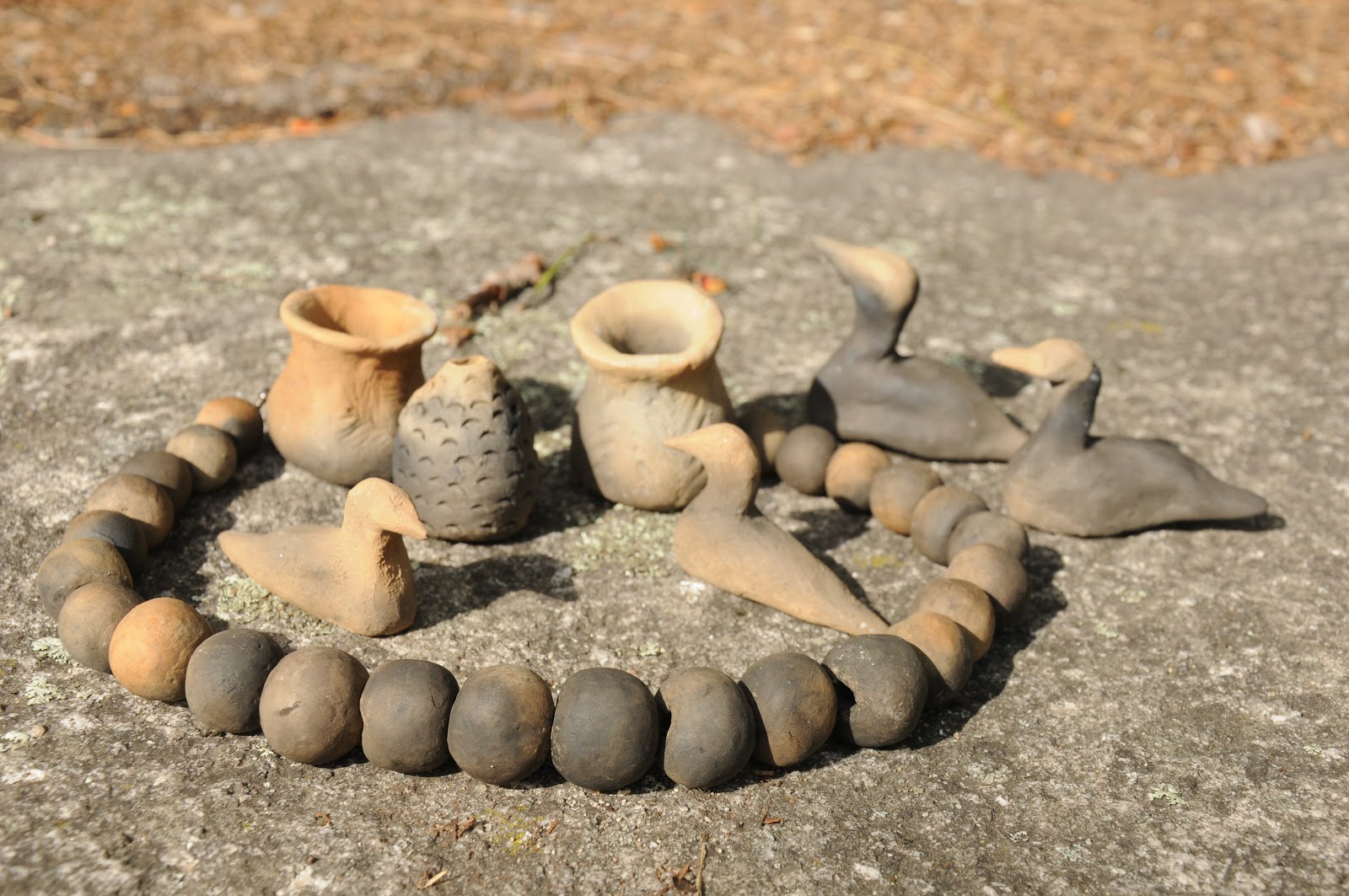 |
| Our haul of clay fired goods |
Through our experience of thrival I feel like I have managed to empty all the accumulated clutter or everyday experience, strip things back a bit, get a bit of the rawness back in, push myself, to laugh when I have been dragging a canoe all day through an impassable swamp that looks like a river on the map, enjoy, immerse in nature and take time to be. Oh yes that's why I do it.
 |
| My new Quetico clay necklace |
Sunday, 23 October 2011
Hapa Zome (beating up leaves with hammers)
This is a wonderful creative technique that I often share with participants on training courses and with the children I work with, This week someone on a course made something so beautiful it reminded me I wanted to share this a bit more widely.
Hapa Zome is the Japanese art of beating up leaves with hammers, pounding natural pigment into cloth. It was developed and named by India Flint who is a colour artist although she suggests that people have probably been pounding colours into cloth for centuries.

 |
| Stacey's hapa zome with clover, dandelions, grasses, berries and petals |
Hapa Zome is the Japanese art of beating up leaves with hammers, pounding natural pigment into cloth. It was developed and named by India Flint who is a colour artist although she suggests that people have probably been pounding colours into cloth for centuries.
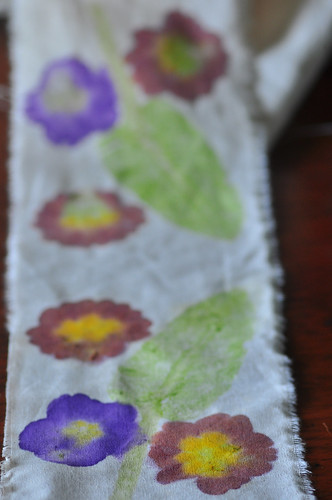 |
| Hapa zome with dock leaves and primula |
The skill level you need to start out with this creative springboard for this is pretty basic. If you can hit things with a hammer you can create beautiful works of art. As demonstrated by a two year old and his mum.


To make hapa zome you need cotton fabric, different weights seem to all work equally well but you do get slightly different effects. The leaves and flowers that you choose make a difference to the effectiveness. Ones that are full of moisture produce the best results.
 |
| Spring crocus flowers |
By folding the cloth in half with the leaf or petal inside you get a mirror image. Once the petal is under the cloth then it is a matter of gently pounding it with a mallet, hammer or even smooth rock. The surface underneath will come through so find a smooth surface to work on. It seems to appeal to all ages and genders equally, I'm sure this is something to do with the cathartic nature of hitting things with hammers!
 |
| Baby nettle leaves |
Monday, 1 August 2011
Learning as much in an hour of play....
"You can discover more about a person in an hour of play than in a year of conversation."
— Plato
I recently spent a wonderful 24hrs with my friend and her daughter, my goddaughter R. Now aged six, this is a child I have known since before she was born, we lived all together for a brief time when she was a baby. I met her mum met at a nature play conference and we worked together for a bit and have been friends for years. We get to meet up too rarely as we now live 250 miles apart. But the reason why I am telling you this is because in that short visit I experienced the most extraordinary hour of play.
In the course of my work I observe children at play and play alongside children a lot. Children playing together often talk and discuss the narrative of the frame in which the play is taking place "You are the dog and I am the mum and then the mum says to the baby, so you have to be the baby but I'm still the mum" sort of conversations.
As an adult invited into that play frame, or, as often happens when I take children into the woods, when I am trying to help children establish a play frame in an unfamiliar environment, a lot of talk can take place. I make observations of what is happening, the child shows me what they are doing, they ask for feedback, ask questions, try to work out the boundaries. This is all part of the containment process, of helping children maintain a play frame.
In this most extraordinary hour of play, the most extraordinary feature was that it was almost entirely silent.
My friend had to go and work for a couple of hours so I offered to look after R. There were a number of options for the morning but R said we should stay at the house and go to play in the little strip of woodland next door. We got up in the morning and my friend went to work. R did a little test of the boundaries.
"I want to watch a programme."
"Ha! the only way we are going to watch TV this morning is if we make the programme ourselves....Oooh actually, we COULD make a TV programme, I have my camera."
"WE could make some TV? "
So we did. R telling stories and singing for the camera, then we went out into the woods and she made a documentary on how to collect things.
 As we were heading back into the house I spotted the stalks on a particular sycamore tree were really long and I pointed them out to R. This was our shared play cue, she collected a few leaves and started winding them together, I collected a few and threaded them into a long chain. During this I offered the usual sort of statements and observations I might with a child when I was working; "You have threaded three leaves together, I think I might hang mine on this tree." Looking for ways we might extend the play frame, But I noticed that R didn't seem to need these and I stopped.

Which gave me an opportunity; I have for a while now had in mind to try and make a geometric cube from leaves. I draw much inspiration from the work of Andy Goldsworthy and as a teenager I saw one of his leafworks boxes in a gallery in the city where I lived. Ever since I had in mind to try and make one. The impetus for which came right back when I recently found one made by another land artist. I've already made one attempt which was a really useful learning process, but the thought of doing something that required so much concentration and time seemed counter intuitive when I was spending time with a lively six year old.

The level of absorption she showed made me loathe to be the one to break it. And we played in parallel she and I. Both in such a state of flow and absorption I am still unsure how much time passed.

We spoke very little each very focused in the challenges we had set ourselves.

Occasionally delighting when something worked well.

Allow the ideas of the other to inspire us in our own play.

Stretching ourselves.

Making observations.

Until we reached a point at which the possibilities had all revealed themselves for now. R made an observation. "The dry leaves are just as good but the brown ones are two crispy." I had made five corners of the box but run out of suitable leaves.

We collected some bits to take back to the house and moved on. The frame which had held us in a state of flow was gone. Naturally extinguished.
I felt as if in that hour of play that I had got to know R in a way that all the phone calls and letters had never revealed. I saw her deep level of ease at being outdoors in nature. I saw how dexterous and creative she is. I saw how motivated and self contained she can be. She saw me too. I explained to her how much I had enjoyed being in the woods with a child who didn't need talking to all the time and that some children I worked with needed my help a lot more. "So is playing your job?" she asked "You are good at playing."
Terms used in the description of the play process have been taken from The Colorado Paper by Gordon Sturrock and Perry Else 1998, P8 onwards.
— Plato
I recently spent a wonderful 24hrs with my friend and her daughter, my goddaughter R. Now aged six, this is a child I have known since before she was born, we lived all together for a brief time when she was a baby. I met her mum met at a nature play conference and we worked together for a bit and have been friends for years. We get to meet up too rarely as we now live 250 miles apart. But the reason why I am telling you this is because in that short visit I experienced the most extraordinary hour of play.
In the course of my work I observe children at play and play alongside children a lot. Children playing together often talk and discuss the narrative of the frame in which the play is taking place "You are the dog and I am the mum and then the mum says to the baby, so you have to be the baby but I'm still the mum" sort of conversations.
As an adult invited into that play frame, or, as often happens when I take children into the woods, when I am trying to help children establish a play frame in an unfamiliar environment, a lot of talk can take place. I make observations of what is happening, the child shows me what they are doing, they ask for feedback, ask questions, try to work out the boundaries. This is all part of the containment process, of helping children maintain a play frame.
In this most extraordinary hour of play, the most extraordinary feature was that it was almost entirely silent.
My friend had to go and work for a couple of hours so I offered to look after R. There were a number of options for the morning but R said we should stay at the house and go to play in the little strip of woodland next door. We got up in the morning and my friend went to work. R did a little test of the boundaries.
"I want to watch a programme."
"Ha! the only way we are going to watch TV this morning is if we make the programme ourselves....Oooh actually, we COULD make a TV programme, I have my camera."
"WE could make some TV? "
So we did. R telling stories and singing for the camera, then we went out into the woods and she made a documentary on how to collect things.


Which gave me an opportunity; I have for a while now had in mind to try and make a geometric cube from leaves. I draw much inspiration from the work of Andy Goldsworthy and as a teenager I saw one of his leafworks boxes in a gallery in the city where I lived. Ever since I had in mind to try and make one. The impetus for which came right back when I recently found one made by another land artist. I've already made one attempt which was a really useful learning process, but the thought of doing something that required so much concentration and time seemed counter intuitive when I was spending time with a lively six year old.

The level of absorption she showed made me loathe to be the one to break it. And we played in parallel she and I. Both in such a state of flow and absorption I am still unsure how much time passed.

We spoke very little each very focused in the challenges we had set ourselves.

Occasionally delighting when something worked well.

Allow the ideas of the other to inspire us in our own play.

Stretching ourselves.

Making observations.

Until we reached a point at which the possibilities had all revealed themselves for now. R made an observation. "The dry leaves are just as good but the brown ones are two crispy." I had made five corners of the box but run out of suitable leaves.

We collected some bits to take back to the house and moved on. The frame which had held us in a state of flow was gone. Naturally extinguished.
I felt as if in that hour of play that I had got to know R in a way that all the phone calls and letters had never revealed. I saw her deep level of ease at being outdoors in nature. I saw how dexterous and creative she is. I saw how motivated and self contained she can be. She saw me too. I explained to her how much I had enjoyed being in the woods with a child who didn't need talking to all the time and that some children I worked with needed my help a lot more. "So is playing your job?" she asked "You are good at playing."
Terms used in the description of the play process have been taken from The Colorado Paper by Gordon Sturrock and Perry Else 1998, P8 onwards.
Subscribe to:
Posts (Atom)
LinkWithin

LinkWithin