Showing posts with label snow. Show all posts

Monday, 6 January 2014

Maslow’s hierarchy of need or why, in winter, we always have hot chocolate..

I was just repacking and checking through the safety bag that I take into the woods with me and I felt like something was missing. There had been a lot more space in the bag over the summer but as the weather changes so does the contents of my safety bag.  So I added another bag, full of small gloves, hats and scarves. There is a well known saying that there is no such thing as bad weather, just the wrong clothes, but it is hard to really feel the full impact of that saying until you see a child, he isn’t engaging with the woods around him, but is stood, hunched, with his hands tucked under his armpits, watching the others.  “Would you like some gloves?” He nods, chooses a pair and runs off to join in. True, it is another thing for me to carry, but the difference it can make to a child’s ability to join in is worth it. I hope most children come prepared to play and learn outdoors but the reality is often they don’t. I think that part of my role as a Forest School practitioner is to try and remove any barriers that stop someone from being able to enter fully into learning, exploring and being in the woods. 


Forest Schools are a place where children can develop self confidence and self esteem and we aim for children to be accessing deep level learning experiences, where they are immersed and in the flow. But like that little boy, people can’t access that powerful, playful learning state if their hands are cold.  The Hierarchy of Needs, as in the theory put forward by Maslow, and extended in this diagram by the Australian child psychologist Louise Porter makes it clear as to why.


Porter describes how after survival and emotional safety, children look for belonging (connectedness, empathy, acceptance) and autonomy (choice, mastery, self-efficacy). Belonging is connected to fun, and autonomy to self-fulfilment. But critically the survival needs; warmth, shelter, food and drink; are at the root of all progress towards self actualisation. If we are concerned or distracted by those needs, we cannot focus on our self-fulfilment or on having fun.  
Children, even quite small children want to look after their own basic needs, they need to know what resources are available, how to use them and have the confidence in you to want to ask for them.  The process of meeting those basic needs can be a vehicle for having fun and feeling proud of your achievements. If you have ever put a temporary shelter with a group of children you soon learn there is lots of fun to be had, shaking the tarpaulin, rolling and wrapping yourself up in it, winding the strings around trees, running through a tunnel like half built shelter. Then, the fleeting moment of pride and satisfaction when the shelter is up and we are ready to get stuck in to our adventures.
For children to be given the language and opportunity to name their needs, and be given the resources to meet those needs is also very important. This little doodle that went into the recent Forest School Association newsletter explores this idea in reality; 


I have noticed that the amount of effort and the designs that children organically come up with for their shelters reflects the weather and their needs. A group of three and four year olds on a snowy morning made a shelter that wrapped them all up, cocoon like inside, protected on all sides. No room for any adults in there though, apart from just enough space to pass in mugs of hot chocolate. On the same afternoon, when the sun had come out and the snow was melting a group of their classmates made a shelter that was entirely different, much more open and spacious, no need to huddle together for warmth any more.

That is why as the weather turns I am checking the supplies of hot chocolate, rinsing out the flask and packing the little gloves into my Forest School safety bag.

*This post, written by Lily, was originally published on forestschools.com in Jan 2011 and is republished here with their kind permission. 

Thursday, 2 December 2010

Who goes there? Who went there?

Snow that is covering lots of the UK at the moment and when I've been out and about I can't help keeping my nose to the ground looking for tracks. Walking up on the moors on Sunday (before it got so deep) we noticed a regular little round regular mark, keeping pace with some human footprints. 
It took a little while for it to dawn on me, we were following the tracks of someone walking with a stick. Further up the hill was a perfect imprint of a walking pole in the snow. We both gleefully pointed it out "look, look he dropped his stick!"

I've written before about how working with children and nature shouldn't be just about naming  but should also be about engaging and inspiring a love of the natural world. 
Children, unless they are brilliant at being still and silent, often miss the opportunity to observe birds and animals in their natural habitat. Tracks are wonderful because  they leave a record of what has happened minutes or hours before you were there. From these you can try and guess what the behaviour was that caused the tracks.

We spotted all sorts of different tracks during the course of our walk:
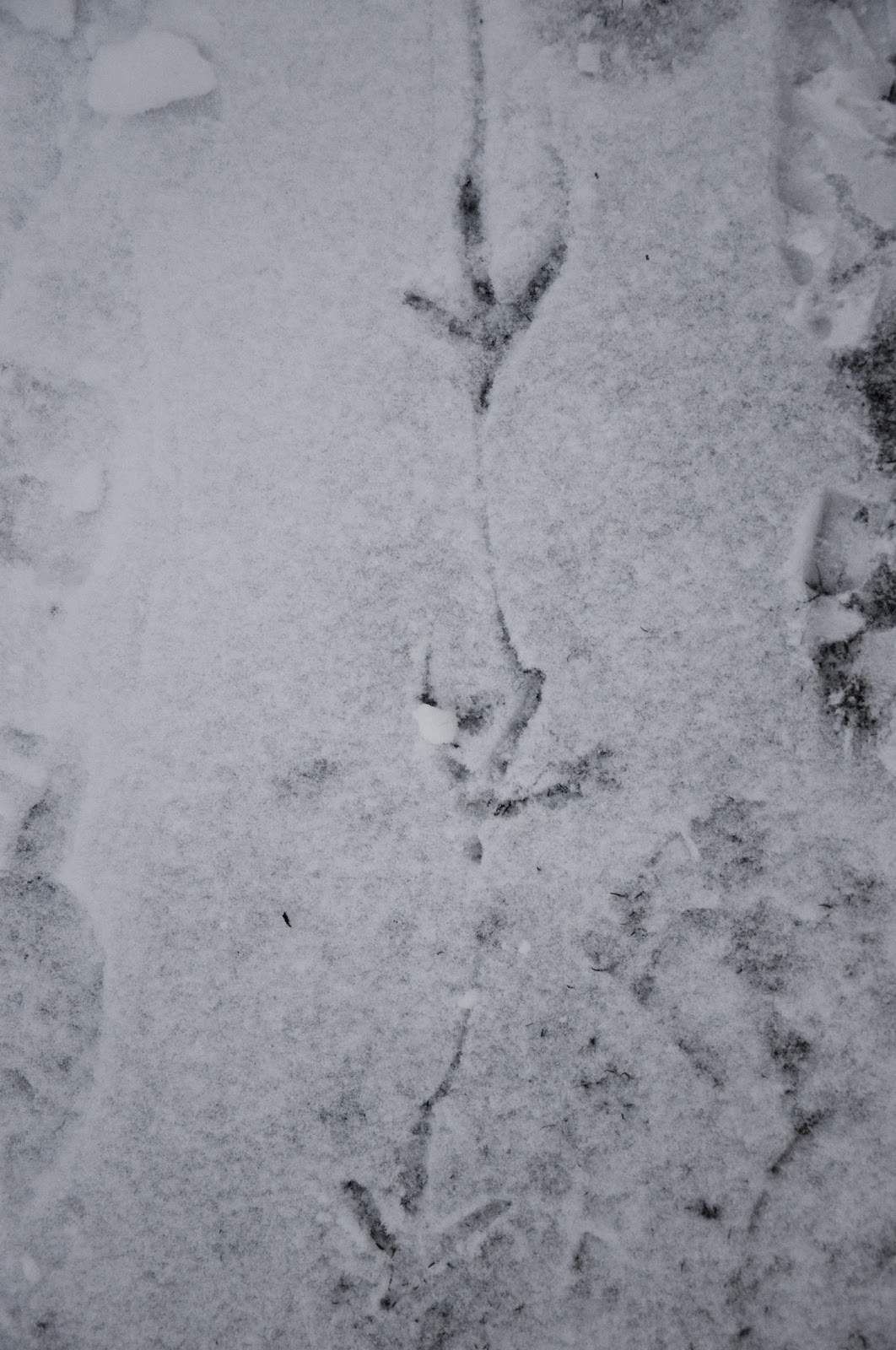
These large bird prints stomped resolutely down a steep slope and then even more resolutely up a steeper slope. We followed them off as they crossed our path, went round a tussock of grass, then followed a stream bed. On the really steep bits we could also see drag marks of a long tail. This has to be a bird that would choose walking over flying, to walk up such a steep slope.


This was something that had a pretty good ability to hop, and a thin tail that dragged on the ground in between it's feet. Maybe it was in a hurry as it crossed the open ground, it didn't seem to bother using it's front feet much. 


More little prints but these include smaller prints. This means it was using it's front feet as well as it's back feet. It also seems to have changed it's mind and gone backwards and and forwards a few times.


Then with a 'hop, hop, wiggle' it has gone down a hole and under the snow. To try and work out what was going on in some off the prints we even did the actions of what we thought would have made them, looking back at our own prints or imagining and acting out what the animal would be doing to leave prints behind like this. 


For children, especially those children who learn kinaesthetically, moving and wiggling around is an engaging way to learn about wildlife; what it does, and why it might be doing it.  Focussing on the behaviour rather than just naming the owner can give you entertaining insights into what is going on around us all the time, we just don't normally see the evidence.

There are lots of  guides to UK animal signs available, some can be downloaded from here and here. The Field Studies Council produce a wonderful laminated fold out guide which I find really easy to understand and especially great for lots of children to look together. All the information is laid out rather than being on lots of separate pages. I find Tom Brown's Field Guide to Nature and Survival for Children  really inspiring. Although it is an American book he does a lot to encourage the tracker to think like the animal and observe behaviour from tracks.

Mud and sand are also brilliant mediums for recording who and what has gone before you. I was first really inspired by tracking when I went out into the Namib desert with a tracker called France. Just listening to him I wanted to know everything he knew. He could tell from the sand who had walked next to who, whether it was an old man or a young man or woman. He could tell exactly where the lizard was hiding out, how quickly the oryx were travelling and he told us the most useful skill  a tracker possesses is to tell who exactly had been laying in the sand next to your wife. He had such a keen observational sense it made me look around me in a completely different way.


If the only footprints you find around where you live are from cats, dogs and humans then track them! Early mornings or after a fresh snowfall are best, before it gets too confusing. You might spot some tracks on a roof like these that Emma of Sew Recycled saw. The drag marks are from a slinking belly, the paws neatly walking in file, it looks like someone is stalking the birds.


On the left are some prints from a rabbit or hare, the four marks made by the small front feet and the long back feet, I always think they look a bit like a spooky face, so I couldn't resist some additions of my own:


Wrap up warm if it is snowing near you and go and see who and what has been wandering around when you weren't looking.

comment FB

LinkWithin

Related Posts Plugin for WordPress, Blogger...

LinkWithin

Related Posts Plugin for WordPress, Blogger...