Showing posts with label play. Show all posts

Wednesday, 3 September 2014

Compound Flexibility

During my years as a Forest School leader one if the attributes that I find myself drawing on is flexibility.  Being able to change plans, put aside my agenda because of the weather, a really interesting discovery in the woods, because of something a child needs or wants to do –my flexibility is core.

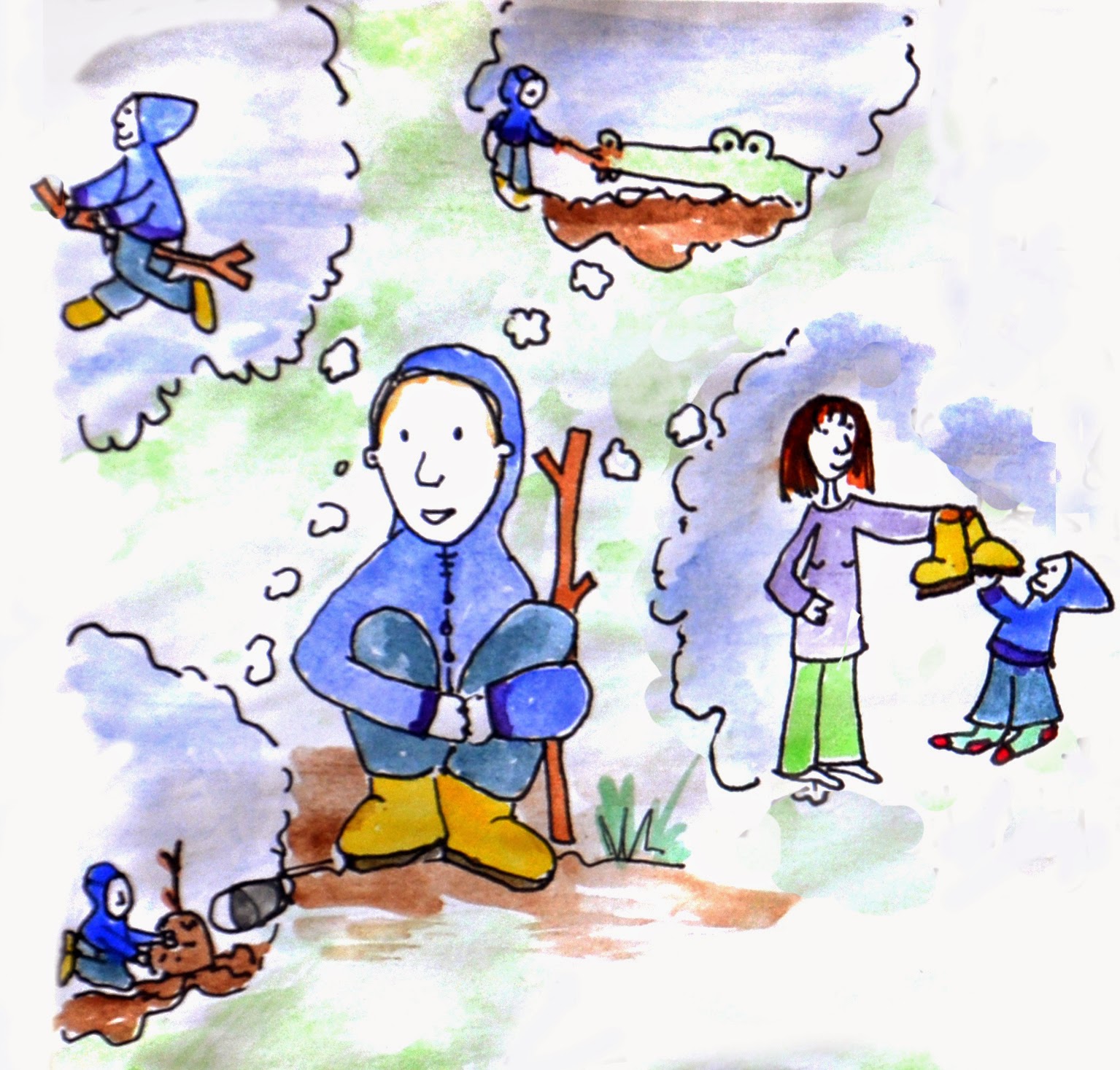
The flexibility of the environment, the range and diversity of resources, how they can be used in lots of different ways. This is what feeds the success of the children. It influences their ability to manage whatever task they have set themselves. This success nurtures the child’s self esteem which in turn makes them more able to interpret their environment flexibly.  It’s a positive spiral.

 It's an idea I explored in a series of drawings for the FSA newsletter recently and wanted to delve a bit deeper into the theory here , this was first brought together by Fraser Brown’s into a theory he called Compound Flexibility; 

“This is not a simple interaction but a complex process wherein, flexibility in the
play environment leads to increased flexibility in the child. That child is then
better able to make use of the flexible environment and so on. There is massive
child development potential in a play setting.” (Brown, F. 2003, ‘Compound
Flexibility’ in “Playwork Theory and Practice, p56)


I really enjoy working in the woods as it is such a flexible environment. But what is meant by a flexible environment? Nicholson (1971) in developing his theory of loose parts, explains it like this; “In any environment both the degree of inventiveness and creativity, and the possibility of discovery, are directly proportional to the number and kind of variables in it”.  
A ‘loose part’ environment includes everything from the the branched trees of a woodland to the cones, stones, mud and twigs that lie within. Nicholson also suggests that a beach is a good example of such an environment. The sand for shaping, the sea ever changing, the rock pools whose life and form shifts with the tide. The flotsam and the jetsam. An environment full of things that fulfil many different roles and functions. A place that can be adapted to our needs and ideas.  This environment also needs the flexibility of the adults in it if children are to be allowed to explore the potential. 


This permission for exploration leads to experimentation. A wide array of elements means that children have the opportunity to combine things in different ways and find the space or material they require to fulfil the need and further the line of enquiry. Children develop by responding to a rich environment. The fewer elements there are to explore, the slower or more restricted the development. The more stimuli, the broader the development. 

One of the key factors in the compound flexibility process is that the child feels in control. This is why self-directed play is so essential for a child’s development. 


This combination of control and challenge is also what gives us good feelings! We try something, we find the resources we need to be successful. The people around us give us the time and space to work things out for ourselves which gives ownership to the success. There are things around us that suggest ideas to us. These are the perfect conditions for feeling really good about ourselves. 


These good feelings are critical to a child's development. Those good feelings mean a child is likely to take a risk and try something else. They are the sort of feelings that govern self acceptance. They are the feelings that contribute to self confidence. Good feelings will keep someone involved, interested and focused in a way no amount of cajoling, bribery or threat can manage. The child is at the centre of the process and wants to be there because it feels good. 


Self confidence also means that a child will try and solve problems when they arise. Self confidence is a desire to keep experimenting even when something goes wrong, the belief that you are able to work things out when things get tricky. This is what we often describe as resilience.  


This is where the cycle connects. The exterior becomes interior and the flexibility becomes part of the child's way of being. The successful experiments suggest new ideas. The problem solving suggests a new goal.  The experience they have just encountered is added to the toolbox of the child's mind. The compounding aspect if this is that the more flexible the child is the more they see the flexibility in the environment.

Conversely a restricting attitude of the adult can shut down that extraordinary potential found in a flexible environment. The compound flexibility process can stagnate if conditions are unsuitable. Children who have little control over their world inevitably have fewer positive experiences, which in turn slows the development of their self confidence. Children who lack confidence are less likely to take risks or try out different solutions to the problems they encounter. Which makes them less flexible and responsive. 

I find that thinking about how these elements interconnect really helps me think about my role and the role of the environment that the children are in and reflect on how these two elements can combine with the child's experience to create powerful opportunities for development. 

Drawings taken from a doodle for the Forest School Association Newsletter Autumn 2014

Tuesday, 26 November 2013

Child led learning or how it feels to not be in charge

Giving control over content and intent of play and learning to children

Child-led learning sounds like it should be easy, just see what the children are interested in and excited by and then follow it. Actually, when you put it like that it is easy and in the context of outdoor learning  allowing the children to lead can be wonderfully simple to implement. There is so much to discover and interact with. It is hard NOT to be learning.  Where child led learning becomes more challenging is in the personal internal battles you face as a practitioner.

I am thinking for example about a time when a group of children decided they would have a ‘bug market’ where they could trade things with each other. They decided they could bring things from home, or trade conkers, interesting leaves and other found natural things.  They asked us to provide materials for signs, sheets to set things out on and they left the session really excited about the upcoming Bug Market.

It was only after they left that we started to realise the gaps we had left open, what sort of things would they bring from home? What were the ethics of trading live insects? Who would decide what trade was fair? How would we agree the rules?
One of the key lessons I have learnt over the years is to never imagine that I am in charge. It can be a real challenge to master my ego, not listen to the voice that says “Well, I know best because I am an adult.”  Or allow the part of me that already sees how this could go horribly wrong to be too dominant. 


When the children arrived for the Bug Market it seemed that the children had all understood what the rules were to be without me having to get them into a discussion. No-one brought their favourite toys to swap, you don’t have insects in a bug market, (and apparently I should have know this!) and the adult role seemed to be to keep currency moving around as more people wanted to be stall holders than to barter. 


But child led learning doesn't start the moment you decide to step back. When I walked into a woodland with a group of nursery children, most of whom had never been in a woodland before, it’s almost like they couldn't see the potential, and didn't know yet how to interact with it. It took a few sessions of going back to those same woods, with practitioners and staff providing encouragement and permission to the children to collect things they saw, asking them to describe their finds and to interact with them, to follow trails of feathers and touch mossy stumps and smooth leaves. Then the children started to notice and to lead. A long worm stopped us in our tracks as we walked up the path. The children are acutely observant, “it is coming towards me,” “now it is going to you,” “it is a letter C for Callum” “it feels sticky, like a fish” They put things in its path to see if that changes the direction it goes in.

When, during the following session we brought magnifying glasses and pictures of the minibeasts they could find they responded really positively and were quickly immersed and interested. Child-led learning can take time to emerge, as group dynamics settle and the children gain the confidence to lead and to believe their ideas will be listened to.  This is one of the reasons why effective outdoor learning takes place over time.


They start to see your role as a provider of resources, ideas, ways and means rather than the instructor, which can often run counter to the normal relationships they have with teachers and other adults.
The natural environment is an unpredictable place, you never know what you will find. You can plan and prepare for certain learning experiences to take place, and they may happen, but what you cannot plan for and only be receptive to, is the unexpected.


"In preparing for battle, I have always found that plans are useless, but planning is indispensable."
–General Dwight D. Eisenhower


Sometimes like with the Bug Market, the children are explicit about the direction they want to take, sometimes child-led learning comes about by following a particular line of questioning and sometimes an observation is the key. In the first week in the woods with another group, William picks up a sharp stone and uses it like a tool; another child watches him and copies, using a stick with the same motion. It occurs to me they are whittling. Even though I don’t usually bring tools in this soon, their behaviour intrigues me and I bring potato peelers for them to whittle with for the next session. 


Outdoor play and outdoor learning provide enough scope for each child to be following his or her own line of enquiry and for them to collaborate with other children and adults. But those internal battles I mentioned... how do you feel about how you are perceived in your role? Not by the children, but by other practitioners, visitors, parents and parent helpers, a passing head teacher or an Ofsted inspector. What happens when the lines of enquiry that the children choose to follow includes squishing living things, making weapons, having battles....? 

*This post, written by Lily, was originally published on forestschools.com in Oct 2010 and is republished here with their kind permission. 

Saturday, 29 December 2012

The adventurer's essentials


Every year we had make most of our Christmas gifts. My nieces and nephews are getting to an age where we can really really enjoy making stuff for them. I wanted to make a den building adventure kit for my oldest nephew. I had some ideas but I knew the Forest Education Initiative Facebook page would come up with more. They are a real source of inspiration and support for lots of people who work outdoors with children. 

I didn't use all the ideas they came up with as I would have needed a truck rather than a bag to put them all in, but check out the thread here if you would like some ideas too. 


But what's in the adventure bag?


Every adventurer needs a wind up torch...


...and some binoculars. We made these binoculars together on Christmas eve.


To go with the note book and twiggy pencil


Some flags to decorate your den,


A really wide selection of fastening; like ropes and pegs, carabiners and those really practical bungees with bobbles on the end. These are just some of the selection. 


 A really useful tarpaulin made from half of an old tent. It already had lots of zips and eyelet holes, hooks and Velcro fastening points. I added a few more eyelets to make it even more flexible and it is waterproof too, which is a bonus. I also added a piece of parachute silk which was a drogue  from a larger parachute. I added lots of eyelet holes to make good fastening points. You can also see the 'instructions' and the corner of the fleecy sit-mat I made using  a bit more of the tent as waterproof backing.


Every explorer needs a treasure map. This one was embroidered with my sewing machine. 


We made an indoor den on Christmas day and cooked the dinner on the fire...

...and we hung up this sign until dinner was ready. 

Luckily it is a  reversible sign so we could welcome people in too. 


Of course any adventurer needs a useful bag to keep all his supplies in... 


...and interesting things to discover.


Wednesday, 28 November 2012

Squirrel Fishing

I thought I'd share with you a little doodle I had in the last edition of the Forest School Association newsletter. This is based on something that happened with a group I was working with a few years ago. 

When you follow the children's ideas you end up in very interesting places! 

forest school, forest schools, outdoor play, nature, children


Sunday, 1 July 2012

Did you play in the mud today?

There are certain elements that regularly feature in my work life; fire, tools, cooking outdoors, climbing, bows and arrows and mud!


To celebrate International Mud Day (29th June) I've collected together this weeks adventures that involved mud. Some of them planned, some spontaneous.


One of the groups of children I am working with in the woods as part of a Forest School project wanted me to set them some challenges so i did. They were all themed around mud but built on the different interests that the group have shown in previous weeks.

Some of the group really like cooking so one of the challenges was to write a recipe that someone else could follow. They spent a lot of time swapping recipes and trying out different ideas.


Some of the other children in the group have been really getting into making bows and arrows so I supplied them with a load of international mud day targets and the challenge to make something that would fire mud at a target.


Their solution was ingenious it was a kind of flippy catapult but it was not quite as effective as their arms as they  got into a mud flinging mud fight! 


Sadly no photos exist of the next bit, which got very muddy.


We always take the same route into the woods and often we find patches of mud to squlech in, puddles to jump in and tracks of people, dogs, bicycles to follow. The journey is an important part of our sessions. Stopping and checking changes; will the muddy spots be there? Will it have dried up? or will it be really really muddy this week?

One of the other groups buried a jar of treasure in the woods last week. Despite us drawing some excellent maps they were not quite accurate enough to find the treasure again so we had to do a lot of digging. 


But, eventually we did find the treasure and then buried it again, and then dug it up, and then buried it and then dug it up and then.....


This boy in particular didn't leave this muddy spot for almost all of the session. Mounding and making exploding volcanoes and digging and feeling the earth with his hands. 


And that is what International mud day is about. Connecting with each other by connecting with the earth, This universal, fundamental element from which we can become disconnected. Some of girls who set up the cocktail lounge above have been really phobic about dirt, touching things and getting their hands dirty or sitting on the ground. So them accepting the mud day challenges felt like a significant step in their growing resilience and willingness to get stuck in and try new things. 

I talked in my last mud post about the importance of equipping children with what they need to try new things. At a family gathering last weekend I made sure my nephew had something to cover up his clothes so that his parents would be happy about him getting stuck in and then I put out this inviting setup for him. 


 He had a wonderful time mixing, stirring, collecting, directing, and creating wonderful recipes. "I am the one who does the cooking, I make the food for everyone."


Mud is always there waiting for us, not just for this one day. Soup and cakes anyone? Cheers!

Monday, 25 June 2012

Baui means build, speil means play, platz means place.

For a few years I managed the transition of the only self-build Adventure Playground in Bradford, the Big Swing, from the statutory into the voluntary sector. Supporting the staff and managing the site through a period of transition gave me a real insight into the value of Adventure Playgrounds and the capability of children and young people.

In April this year I spent a week in Hamburg and Berlin with a study tour for play professionals co-ordinated by ip-dip.com and www.meynellgames.org. The tour took us to scrapstores, public parks and playspaces, community provision, waldkindergarten and green school playgrounds. We also visited a number of Adventure Playgrounds in both cities.


We first heard about the Adventure Playground movement in Hamburg and Berlin from Christe-Beate of the European Play Association (EPA). She was one of the first women to work on an adventure playground in Germany and a real advocate for play. What we hadn’t really understood was how the playgrounds fitted into society in the two cities;


Bauispeilplatz is known locally as 'the Baui'. Baui means build, speil means play, platz means place. I do love a German compound noun! 

Tony from the EPA playground invites us to visit the Baui with him. It has been open for nearly 30 years, since 1984. The tall tenement style houses crowd around the playground but mostly relationships with the local people are good, especially after the death of the Baui cockerel!


Armin, one of the playworkers, talked to us about the Adventure Playground and the things that children can do; jumping, building huts, lighting fires, arts and crafts playing football and keeping chickens. So far so familiar; but if you have never been to an adventure playground this doesn’t really convey a feeling of the place. The very first adventure playgrounds in Britain in the 1950’s were called "junk playgrounds" or "waste material playground" and this gives more of a sense of how a good adventure playground looks. 

“The junk playground should be characterized by signs of wear and tear. It should be a safety valve to children whose town existence otherwise keeps them nice and well-ordered.
John Bertelsen (1959)


The Baui definitely lives up to this description, like a refugee camp of the anarchies of childhood with heaps and piles, self expression and half finished and half started projects. This was also the day that I managed to completely break my camera in a game of tig-off-ground. This can be a dangerous place. Armin talks about the perception of how dangerous the playground looks; "children are not stupid, they can see dangers and learn to handle them and experience them and go to their limits. It is better they go to their limits here rather than in the Reeperbahn (the red light district two streets away) or with drugs" There are very few serious injuries. In 18 years Armin has seen 3 or 4 serious injuries. But many small injuries occur. 


Kai and Lukas are both young people who have grown up in the playground. Kai has been here 15 years, I ask him; "does it look the same?" "No! No way. It always changes." he describes himself as a child of the playground, a native. On an average day 90 children come to the Baui, mostly from close by, within 500 meters of the gates. The philosophy is that the gate is always open. No age limits, tiny children up to older teenagers. Parents come too, for advice, support and to socialise.


Most funding for the playground and the projects come from the City of Hamburg through Youth Project, Preventative and Social Deprivation funding streams. "Applications each year are the sword of Damacles"!  Although the Baui has been very lucky, or very creative and has escaped the worst of the cuts, the Ministry of Social Affairs is restructuring work with young people and there will be a move to another department which will inevitably bring about a new agenda, based more on individual interventions. The staff feels this is a contradiction to the philosophy of 'open gates' and makes the Baui become part of the authority. This may change how the baui is seen by the locality. On the day of our visit talks are going on at the town hall that will influence their ability to offer open access in the future. Charitable funding only makes up 5% of budget. Charitable funding is not an established way of working in Hamburg. 


Well ordered tool systems. I take note; hammers, numbered. With
 a board showing who has each hammer. Tickets issued with tools.
Changes to the school day in Hamburg are impacting on the playground. Children used to come after school at 1pm and eat lunch with the staff in a big communal meal, but this ended now the school day ends at 3pm . Some schools in St Pauli now send school groups here as part of the school day. The children come with the teacher, the playground offers activities but fundamentally what takes place is free play determined by the children. "Lessons after the Baui are calmer, when the children go back to school."


The change in the structure of the school day was seen to be a challenge at first, but actually by working closely with schools they are meeting and working with more children and families. They also do 'play actions' in schools and take groups out canoeing, on camping and hiking holidays to the countryside. The playground is relied on by many families to help them with things like reading letters or helping with social issues. 


There are 20+ playgrounds across Hamburg, all of which work in different ways. The playgrounds network together once a month and this playground is also part of local networks. They use these networks to support children who are finding it hard to access other provision. 

We have lunch at the Baui, this is still such a traditional part of the Baui day, staff, children and visitors all sit down together and eat. When children finished school at 1pm there would be lots of children here but today there are a few young people and 3 or 4 children under 12. Annie tries her German on one boy who is making faces at the green bits of leek in his soup. "Es ist grün" :(   Annie asks him in German if he thinks it will make him big and strong to eat his greens. A member of the staff asks again if he thinks so. "I don't understand English" he replies, poking his leek with his spoon. "But, she asked you in German!"... 


As everyone arrives there are greeting and hugs for staff and young people alike. There is a very relaxed family feeling.  Armin says that he has worked with generations of the same family, Bettina, who was one of the founders in 1984 still works here and I imagine there will soon be grandparents of children who come to the playground who were children on the playground themselves.

The hen house

We had passed another adventure playground when we had been walking around Hamburg, then, from the train we spotted another that looked very interesting so we ranged through the Sternzschanze and St Pauli districts, following(ish) the line the train had travelled. Annie's nose for direction is impeccable and we found another local adventure playground that is also protesting against the same cuts. It is closed now but we peer through the fences and look at the posters and signs on the fence. The realisation strikes us, we have seen playgrounds similar to these in the UK, some of our group have worked in or on them, but they are not in every neighbourhood like this. A map of all the playgrounds protesting the cuts shows the scale, and these are old, established parts of the community.


The dots on the map; bottom left, show the members of the
  bauiplatz association in Hamburg
When we move onto Berlin there are more chances to visit Adventure playgrounds. Founded on 2nd April 1990, less than 6 months after the fall of the Berlin wall, Kolle37 was the first adventure playground in former East Berlin. The impact of such provision in the political climate of the time is hard to fathom. It must have been a phenomenal leap for the staff involved, the organisation symbol has within it the anarchy sign and this speaks to me of how radical it must have felt at that time to be creating a project like this. 


Martin, who was the originator of the project, tells us that the things that most adventure playgrounds have in Germany are hut building areas, a fire place, the use real tools and places to keep animals. He describes the playground as a combination of 3 elements:
"- Dangerous supervised situation.
- You can build up and destroy.
- Social connections are needed, you cannot build a hut alone." 
The hut building area is at one end of the playground. They take it all down every year and then hold a hut building festival between March and June and rebuild. They have a well set up craft workshop, with a Blacksmith's forge and power tools. There is a replica stone age round house on the site which is used with schools for teaching lessons about stone age technology and history. There is an area designed for smaller children and when we look around there is a group of 2-3 year old children attending Kindergarten sessions. 


The kinder area

The main building on the playground was finished in 1999 and is the heart of the company Netzwerk Kultur/Speile . The main foyer is big enough for all the tables which are used for lunchtimes with the children. There have not yet been the reforms to the school day like there is in Hamburg so children finish school at lunchtime, they also have space they can go and do homework before going out into the playground. Kolle37 has a contract with the families of about 20 children to provide daycare on the playground but most children are free to come and go. 

The majority of the funding comes from The city of Berlin which provides for 3.5 full time equivalent staff which is used for 6 part time posts. The daycare group, of 20 children, funds another 1 full time equivalent post. The children who come to free play sessions are 6-16 years old. We ask about the reason behind the age limit; “They have to be over 6 because whilst the staff is responsible for everything they can't see everything. Younger children might not be able to perceive the dangers like loose planks or sticking out nails.”


We later come back to Kolle 37 to meet up with one of the playworkers. The site has 7 entrances so it is easy for children to come in and to leave but easy for adults too, we are asked to arrive just as the children are leaving. It's really important to Kolle37 to be an adult free space, so adults don't interfere with children's play processes, but also because of concerns about paedophiles or inappropriate adult behaviour. All adults on the site can be challenged as to why they are there.


"Parents corner." During the week parents are encouraged
 to spend time chatting with each other but away
 from the main part of the playground.

Marcus describes the way the playground works. “Every kid is welcomed and they try to find out their interests and tell them the rules such as don't climb on this particular roof. Some rules you can't put in a positive way. They can climb on all the other roofs but this one is not so safe.”
Every two weeks children and staff get together to talk about what is good, what is annoying and what rules work. Every person has one voice so the children can out-vote the pedagogues (the staff). There is a red, yellow and green card system similar to the one we saw in the playgrounds in Hamburg. Cards can be used as currency, yellow and red are given out for bad behaviour, green for good, which you can swap for more nails, more lunch, to make a phone call etc.

the rules
I am intrigued by this, we talked about similar systems on the playground I managed, the pros of being able to discourage behaviour that the staff found difficult to manage, the cons of unduly adulterising the children’s play process, the inconsistency of who got cards for what from the different staff members, the fact that the children who would buy in to such a scheme are not the ones who the staff needed to engage the most etc etc, the arguments went back and forth and we decided not to bring a scheme in. But here most of the playgrounds use this sort of scheme. Apparently the children here voted to remove this rule but when they found they couldn't use green cards to earn their lunch anymore it came back. 

The rules stay in place for at least a month. There is a mail box where they make suggestions based on things that come up during their play but rules are only discussed during meetings. Children can make petitions if they feel they are strongly attached to a particular rule or can't make the meeting. 


Sale of craft work made by children.
I did manage to get one of these back on the plane! 

The children come here by themselves after school, they have lunch and do homework before doing any projects they have in mind. There are special projects too at different times of year, like blacksmithing or the hut festival. I’m initially challenged by the idea of the hut building festival. One of the elements that we noticed on the Big Swing Adventure playground was the natural cycle of creation and destruction. The building of dens and treehouses which would gradually be abandoned and the materials ransacked for a better, more exciting project. This had a seasonal element, winter tended to be a time of destruction with the most fervent growth in spring.


The Hut Building festival at Kolle 37 means every hut was torn down and rebuilt at the same time.  Children work on one hut in the plan but they can change groups and huts at any time, they build the small model huts before hand they don't have to realise this plan exactly but it helps them plan how to make a hut. Each hut has the same space; 2m x 2m and they are limited to 4m in height. The kids have to dig a hole as deep as your knee for the posts to go into. Then the post goes in with rocks and is packed in well. Each hut gets 200 starting nails. It used to be 20 per person, but the children voted to change that.  When the hut is built they can spend a night in it. Occasionally children hide hammers so they can come and build in the evening. Occasionally they come in and destroy others houses but not so often. All much more structured than the processes I am used to.


 But when you explore the hut building area you can see how many huts they have managed to pack into what is in effect a tiny space, you sense the care and attention and skills these huts have been created with. Some look barely begun and are being built by very small children. Some are sophisticated and have complex security systems (I manage to overcome the most complex system for the best view by leaning a pallet against a wall and shimmying through a high window!) 


"Six years ago there was a very different social demographic. Kids needed something to do because they had nothing else." This is still true to some extent and some children are at Kolle37 all the times that it is open because they don't have a parent at home or because they don't have a parent who cares about them. There are an increasing number of children from more affluent families too, which was a challenge for staff but they have had a growing realisation that all children just need space to calm down and just because they have lots of lessons like piano or ballet they still need time and space to be themselves. 
“Here there is a levelling of the social structure because you will get dirty and you can't wear designer clothes everyday. You do need people to work together to make a hut.” 

Whatever they want to do they the staff help them realise it. 


For more about Adventure playgrounds in the UK;

comment FB

LinkWithin

Related Posts Plugin for WordPress, Blogger...

LinkWithin

Related Posts Plugin for WordPress, Blogger...