Showing posts with label wildlife. Show all posts

Friday, 13 June 2014

Bug book hotel

I have spent an inspiring couple of days in Scotswood Natural Community Garden. It's a stunnning place on so many levels; just two to three acres in very urban part of Newcastle, thriving with trees, flowers, birds, insects, foxes, ponds and people.

The garden is a real treat for the senses, with lots to discover. I was taken with these book bug hotels that Hive Arts made with the Garden for their Pollination Street project.  


So much so that as soon as I got home I started hunting through the bookcases and garden for suitable materials. 
The first step was to drill a few holes into a log from the firewood pile. 

I chose a few different hole sizes. This sort of habitat will be appealing to a range of small creatures like ladybirds, their larvae, lacewings and solitary bees. 


Then I chose a book with a hard back cover. This was a really tricky thing for me. I'm a real book worm and was always told that you should never do bad things to books (or paintbrushes). But I overcame my conditioning, found a book on Ecology that was very out of date and I think the author would approve of it becoming a habitat!


The last ingredient was a bundle of hollow stems from plants that had died over the winter. When I tidy up all the dead stuff in spring I keep this for fire lighting so I still had a ready supply. You could use bamboo canes instead of hollow stems. 


Using a drill I made holes in the spine of the book. Then got a stick with two pieces of long wire wrapped round it that would hold everything together. 


Materials assembled! I used quite a lot of trial and error as well as some pliers to get the wire tight enough and to make sure everything was securely held together. I started by threading two wires through a hole drilled up through the log, then took both wires round the bundle and then through the book. Pushing extra stems through the bundle helped make everything tight and I could use the left over wire wound together to make a strong hanging hook. 


With everything assembled it was ready to hang. I chose a sheltered spot in a tree out of the sun and weather. Hive Arts were inspired by Alec Finlay's 'Bee Library' at the Yorkshire Sculpture Park. 


 I hope they like their new home.

Wednesday, 28 November 2012

Squirrel Fishing

I thought I'd share with you a little doodle I had in the last edition of the Forest School Association newsletter. This is based on something that happened with a group I was working with a few years ago. 

When you follow the children's ideas you end up in very interesting places! 

forest school, forest schools, outdoor play, nature, children


Thursday, 2 December 2010

Who goes there? Who went there?

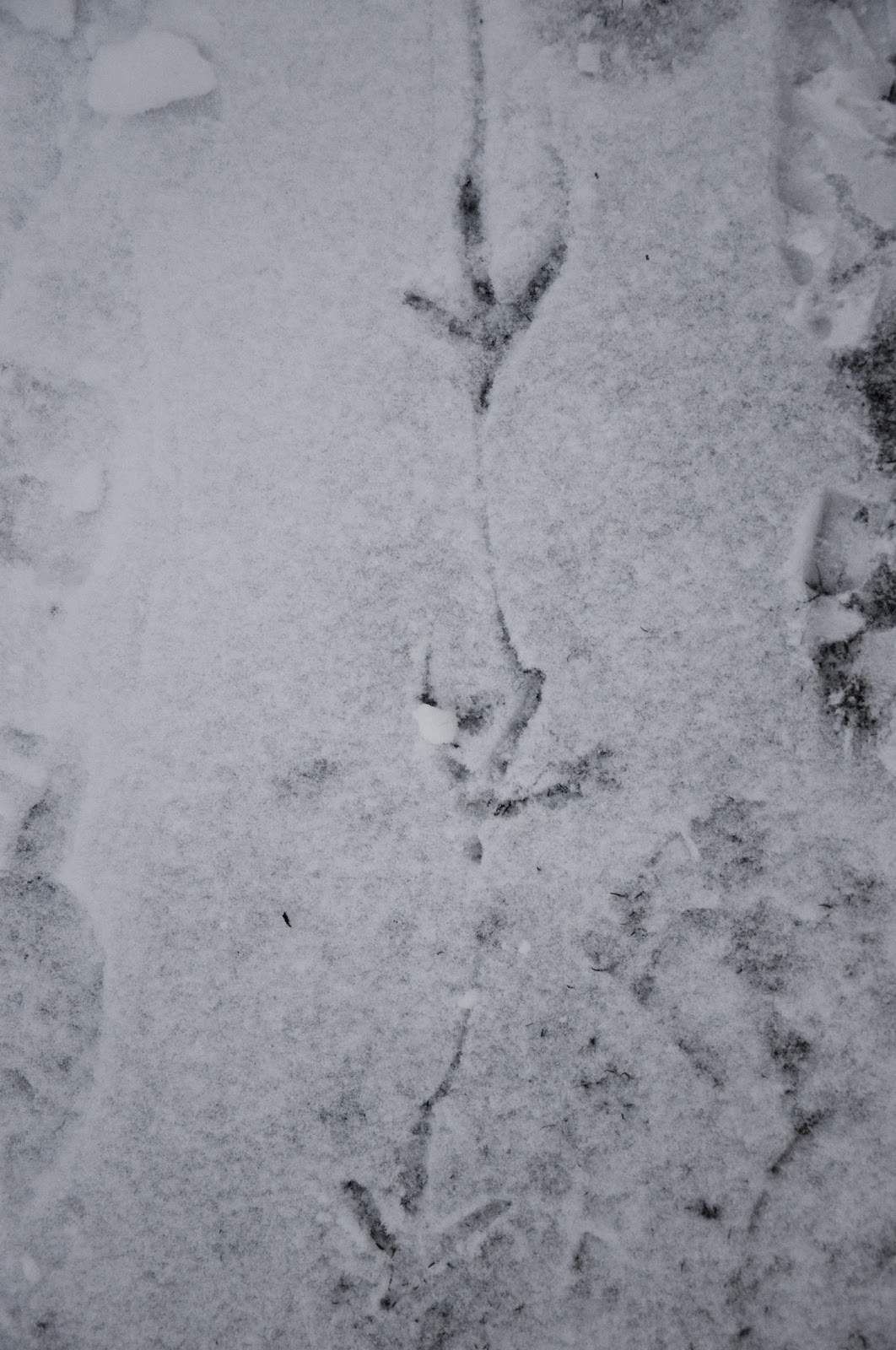
Snow that is covering lots of the UK at the moment and when I've been out and about I can't help keeping my nose to the ground looking for tracks. Walking up on the moors on Sunday (before it got so deep) we noticed a regular little round regular mark, keeping pace with some human footprints. 
It took a little while for it to dawn on me, we were following the tracks of someone walking with a stick. Further up the hill was a perfect imprint of a walking pole in the snow. We both gleefully pointed it out "look, look he dropped his stick!"

I've written before about how working with children and nature shouldn't be just about naming  but should also be about engaging and inspiring a love of the natural world. 
Children, unless they are brilliant at being still and silent, often miss the opportunity to observe birds and animals in their natural habitat. Tracks are wonderful because  they leave a record of what has happened minutes or hours before you were there. From these you can try and guess what the behaviour was that caused the tracks.

We spotted all sorts of different tracks during the course of our walk:
These large bird prints stomped resolutely down a steep slope and then even more resolutely up a steeper slope. We followed them off as they crossed our path, went round a tussock of grass, then followed a stream bed. On the really steep bits we could also see drag marks of a long tail. This has to be a bird that would choose walking over flying, to walk up such a steep slope.


This was something that had a pretty good ability to hop, and a thin tail that dragged on the ground in between it's feet. Maybe it was in a hurry as it crossed the open ground, it didn't seem to bother using it's front feet much. 


More little prints but these include smaller prints. This means it was using it's front feet as well as it's back feet. It also seems to have changed it's mind and gone backwards and and forwards a few times.


Then with a 'hop, hop, wiggle' it has gone down a hole and under the snow. To try and work out what was going on in some off the prints we even did the actions of what we thought would have made them, looking back at our own prints or imagining and acting out what the animal would be doing to leave prints behind like this. 


For children, especially those children who learn kinaesthetically, moving and wiggling around is an engaging way to learn about wildlife; what it does, and why it might be doing it.  Focussing on the behaviour rather than just naming the owner can give you entertaining insights into what is going on around us all the time, we just don't normally see the evidence.

There are lots of  guides to UK animal signs available, some can be downloaded from here and here. The Field Studies Council produce a wonderful laminated fold out guide which I find really easy to understand and especially great for lots of children to look together. All the information is laid out rather than being on lots of separate pages. I find Tom Brown's Field Guide to Nature and Survival for Children  really inspiring. Although it is an American book he does a lot to encourage the tracker to think like the animal and observe behaviour from tracks.

Mud and sand are also brilliant mediums for recording who and what has gone before you. I was first really inspired by tracking when I went out into the Namib desert with a tracker called France. Just listening to him I wanted to know everything he knew. He could tell from the sand who had walked next to who, whether it was an old man or a young man or woman. He could tell exactly where the lizard was hiding out, how quickly the oryx were travelling and he told us the most useful skill  a tracker possesses is to tell who exactly had been laying in the sand next to your wife. He had such a keen observational sense it made me look around me in a completely different way.


If the only footprints you find around where you live are from cats, dogs and humans then track them! Early mornings or after a fresh snowfall are best, before it gets too confusing. You might spot some tracks on a roof like these that Emma of Sew Recycled saw. The drag marks are from a slinking belly, the paws neatly walking in file, it looks like someone is stalking the birds.


On the left are some prints from a rabbit or hare, the four marks made by the small front feet and the long back feet, I always think they look a bit like a spooky face, so I couldn't resist some additions of my own:


Wrap up warm if it is snowing near you and go and see who and what has been wandering around when you weren't looking.

Wednesday, 6 October 2010

WildPlay Kitbag

Oooh, I was just looking for an creature footprint ID sheet that I have been using since I worked at Herefordshire Nature Trust. I couldn't find it in my filing system anywhere, but I remembered there was a copy in the the PDF that went with the WildPlay Kitbag that I complied with Jo Polack in 2005 (ish I am a bit rubbish with dates!).

www.herefordshirewt.org/wildplay/downloads/WildplayKitbag.pdf

We made a really fun film of different environmental play projects we were involved in at the time, I don't know if it is still available but the WildPlay project is still going strong doing lots of wonderful wild playing across Herefordshire.
www.herefordshirewt.org/wildplay/

The names of things...

Often on training courses, when I ask what people want to get out of the day the response is that they want to know the names of more things in the woods. Inside there is a part of me that baulks at this. I love learning and sharing the names of flowers, trees, insects and birds with my adult friends but if we wish to stimulate children’s curiosity, interest and excitement about the natural world we have to be mindful of the adult habit of naming. Finding the name is not the end of the discussion.  Names are fun and interesting, revealing stories and descriptions. For a child however, interest is stimulated more by the senses and the habits of flora and fauna; what does it smell like? how does it feel? what do you think it eats?


Imagine you were at a party and all you were told about the other party goers was their name, could you be expected to feel like you had developed a relationship with all of them? What you do at a party is find out more about the other people, ask them of their interests, their likes and dislikes.
We should treat nature like a party and learn to mingle.


This does not mean that a Forest School leader should not have knowledge and identification skills. We should try to act like a good party host who assists the mingling process; “meet Jeff, did you know he can balance a chair on his nose?” is the equivalent of a child centred approach to exploring nature, our role is to develop fascination and interest; “have you seen this insect? If we touch it gently it will jump, that’s why it gets called a froghopper.”

Knowledge and identification skills aid a Forest School leader’s ability to expect and anticipate the woodland as a resource for further discovery. If you know what a certain tree is, you will have a better understanding of its properties. This allows the children to succeed in tasks you set them. For example if you ask a child to split a piece of wood with a billhook and give them a piece of seasoned elm, you are setting them up to fail. But to give the same child a piece of green ash will give them a satisfying experience will have a positive impact on their learning, self esteem and understanding.


The ability to identify species also aids our ability to keep the children safe. If we can recognise a nettle we are able to point it out to another as something that may cause harm. A child who walks too close to a nettle will pretty quickly  learn how to identify one again. If we know the difference between a horsefly and a hover fly we can reassure children is they have nothing to fear.
Everything in nature has different properties and habits and can stimulate learning, through the discovery of these habits, but we don't always have to name it to know it.

comment FB

LinkWithin

Related Posts Plugin for WordPress, Blogger...

LinkWithin

Related Posts Plugin for WordPress, Blogger...