Showing posts with label pedagogy. Show all posts

Wednesday, 3 September 2014

Compound Flexibility

During my years as a Forest School leader one if the attributes that I find myself drawing on is flexibility.  Being able to change plans, put aside my agenda because of the weather, a really interesting discovery in the woods, because of something a child needs or wants to do –my flexibility is core.

The flexibility of the environment, the range and diversity of resources, how they can be used in lots of different ways. This is what feeds the success of the children. It influences their ability to manage whatever task they have set themselves. This success nurtures the child’s self esteem which in turn makes them more able to interpret their environment flexibly.  It’s a positive spiral.

 It's an idea I explored in a series of drawings for the FSA newsletter recently and wanted to delve a bit deeper into the theory here , this was first brought together by Fraser Brown’s into a theory he called Compound Flexibility; 

“This is not a simple interaction but a complex process wherein, flexibility in the
play environment leads to increased flexibility in the child. That child is then
better able to make use of the flexible environment and so on. There is massive
child development potential in a play setting.” (Brown, F. 2003, ‘Compound
Flexibility’ in “Playwork Theory and Practice, p56)


I really enjoy working in the woods as it is such a flexible environment. But what is meant by a flexible environment? Nicholson (1971) in developing his theory of loose parts, explains it like this; “In any environment both the degree of inventiveness and creativity, and the possibility of discovery, are directly proportional to the number and kind of variables in it”.  
A ‘loose part’ environment includes everything from the the branched trees of a woodland to the cones, stones, mud and twigs that lie within. Nicholson also suggests that a beach is a good example of such an environment. The sand for shaping, the sea ever changing, the rock pools whose life and form shifts with the tide. The flotsam and the jetsam. An environment full of things that fulfil many different roles and functions. A place that can be adapted to our needs and ideas.  This environment also needs the flexibility of the adults in it if children are to be allowed to explore the potential. 


This permission for exploration leads to experimentation. A wide array of elements means that children have the opportunity to combine things in different ways and find the space or material they require to fulfil the need and further the line of enquiry. Children develop by responding to a rich environment. The fewer elements there are to explore, the slower or more restricted the development. The more stimuli, the broader the development. 

One of the key factors in the compound flexibility process is that the child feels in control. This is why self-directed play is so essential for a child’s development. 


This combination of control and challenge is also what gives us good feelings! We try something, we find the resources we need to be successful. The people around us give us the time and space to work things out for ourselves which gives ownership to the success. There are things around us that suggest ideas to us. These are the perfect conditions for feeling really good about ourselves. 


These good feelings are critical to a child's development. Those good feelings mean a child is likely to take a risk and try something else. They are the sort of feelings that govern self acceptance. They are the feelings that contribute to self confidence. Good feelings will keep someone involved, interested and focused in a way no amount of cajoling, bribery or threat can manage. The child is at the centre of the process and wants to be there because it feels good. 


Self confidence also means that a child will try and solve problems when they arise. Self confidence is a desire to keep experimenting even when something goes wrong, the belief that you are able to work things out when things get tricky. This is what we often describe as resilience.  
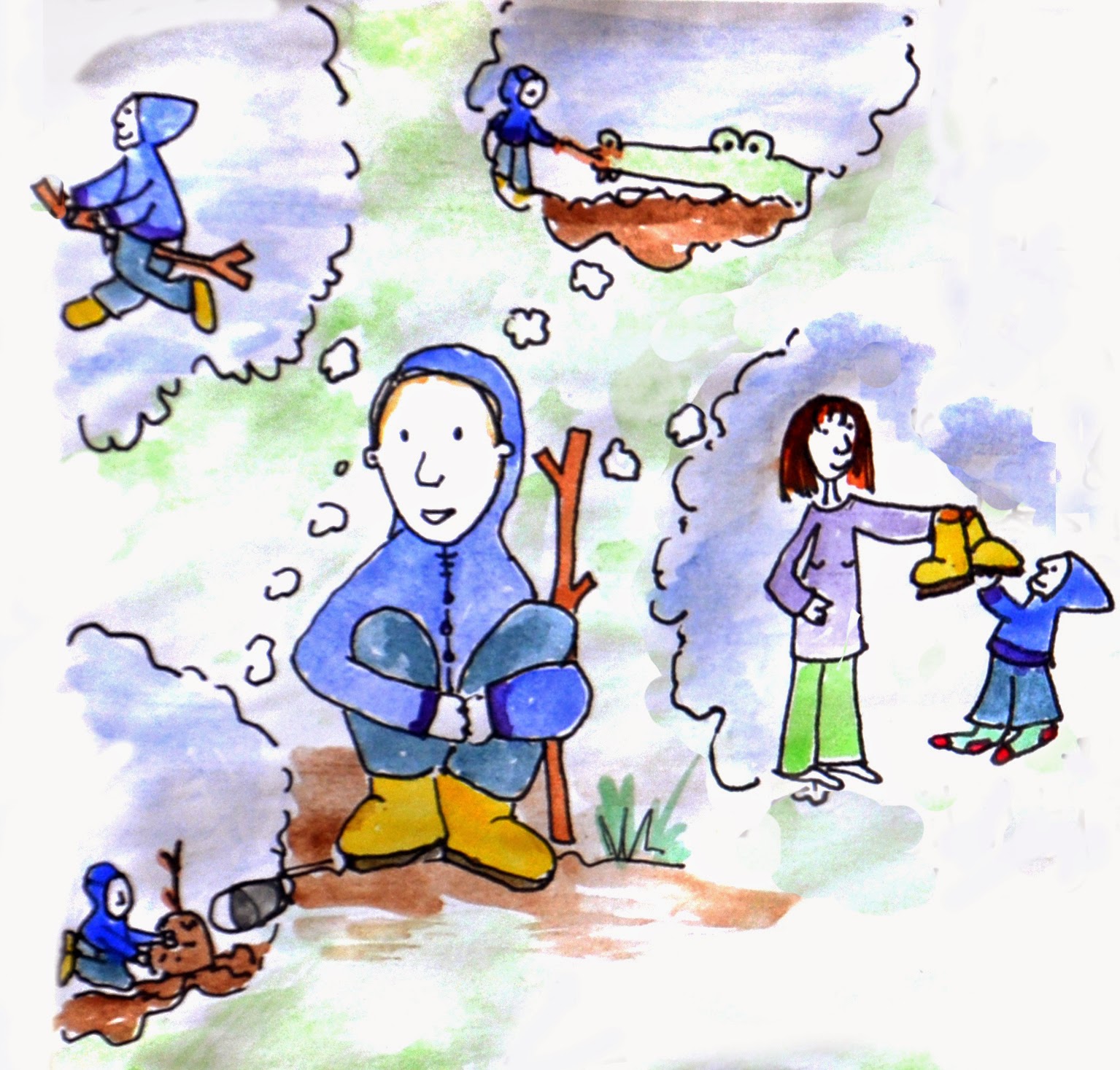

This is where the cycle connects. The exterior becomes interior and the flexibility becomes part of the child's way of being. The successful experiments suggest new ideas. The problem solving suggests a new goal.  The experience they have just encountered is added to the toolbox of the child's mind. The compounding aspect if this is that the more flexible the child is the more they see the flexibility in the environment.

Conversely a restricting attitude of the adult can shut down that extraordinary potential found in a flexible environment. The compound flexibility process can stagnate if conditions are unsuitable. Children who have little control over their world inevitably have fewer positive experiences, which in turn slows the development of their self confidence. Children who lack confidence are less likely to take risks or try out different solutions to the problems they encounter. Which makes them less flexible and responsive. 

I find that thinking about how these elements interconnect really helps me think about my role and the role of the environment that the children are in and reflect on how these two elements can combine with the child's experience to create powerful opportunities for development. 

Drawings taken from a doodle for the Forest School Association Newsletter Autumn 2014

Wednesday, 27 August 2014

Badges of honour.

Many years ago I talked with my friend Martin about the idea of the badges of honour of outdoor play. Martin wrote about this in www.playengland.org.uk/media/130593/play-naturally.pdf,  that dirt, stains and smells can be treated like ‘badges of honour’, ‘evidence of successful outdoor play’ and learning. Like all good ideas I'm still mining it. 


I recently worked in the woods with groups of children and adults as part of a summer school of transitions. Groups came to me for a full day at a time. One of my challenges was setting the expectations with staff (who were only with me for a day) around allowing the children to get immersed in activities and reinforcing with the children that it is OK to get muddy and involved. 
This is when the badges of honour turned from a metaphorical notion to a literal tangible thing. 


I filled my pockets with them and brought them out at opportune moments, a girl who raced off and find the right sorts of sticks off the den she was making, met with an 'uuuugh' from her friends as she ran through a puddle. 
A badge of honour for muddy shoes changed the story and the girls raced off together. 


A staff member complaining loudly about getting mud on her leggings actually looked kind of proud to receive the first badge of honour off the day. 

Sitting, quietly after putting a plaster on a cut, I shared with the child that he had a badge of honour too, that cuts sometimes happen because you are living life adventurously. 

As the summer holidays come to an end and looking down at my own hands and legs I can recognise there are badges of honour here too.  


Sunday, 22 June 2014

Look after yourself, look after each other and look after the place we are in.

There are many ways that I have used over the years to set ground rules with children. It always boils down to this though; 


How this is works is negotiated as we need to know it, sometimes in the middle of a game we might need to stop and work out the rules and make sure they work for everyone. This process of making group agreements rather than ground rules is an important part of developing social skills and having empathy for other people's needs.


With this comes an element of responsibility for your own self. Knowing where the boundaries are and making sure you stay with the group is important. As is the ability to notice your needs and do something about them.


This can't come at the cost of the place we are in. We should remember that we are visitors, in the home of the things that live in the woods and wilds. 


I've been making some resources to help focus on these three responsibilities and I'm interested to hear how you start these sorts of conversations with the children you work with.  


Monday, 9 June 2014

Walking alongside

Sitting around the fire at a recent Forest School conference a fascinating discussion developed about the nature of the pedagogy we employ. My friend Annie, of Get Out More, remembered a conversation she and I had had a few years ago. We had been discussing the amount of knowledge that we feel we should have in order to help someone else learn. She had said to me that she had noticed something that had helped her, the realisation that you only need to be one step ahead of where the learners are. We laughed when she recalled that my answer had been "One step! As much as that?"


As I reflect on this conversation later I realise that there is a deeper truth in this idea, held in the approach to learning employed in Forest School. If we look at the word 'pedagogy' it's roots hold the secret of the skill we that we try and master, the "science and art of teaching"; 
In Ancient Greek and Roman culture the pedagogue was the adult, often a trusted slave, whose role it was to walk with the child in the street, carrying their bags and modelling how to behave in a range of situations. He or she was not the teacher who directed the acquisition of subject knowledge. The pedagogue was literally the person who walked alongside the child to the place where they learned. Maybe one step ahead, if as much as that.  


My husband and our long legged dog love to go striding out across the moors near our home. Both covering ground at great speed and exhilarating in the wild weather. I go with them sometimes but it requires careful negotiation. I have a tendency to get distracted; an abandoned egg shell from a moorland nest, a wildflower blooming in the moss, concentric circles of vivid lichens. Then, when I look up they are gone. Little specks away up the hill, (always uphill) and I have to really motivate myself to catch up. I arrive, out of breath as they wait patiently, ready to move on again.

When we try and keep pace with each other, it is much easier to get into the flow of walking. I have to walk a little faster and push myself. He has to pause and take notice of little things. The dog runs in circles around us both. But we are walking together, maybe one of us is one step ahead, if as much as that. 

This is the ideal that I try and strive for in my own practise and in the sharing of my knowledge. I try to walk alongside the children. Delighting in the observations they choose to share with me, encouraging them to push themselves a little. Rather than rushing ahead, leaving them to struggle on their own, expecting them to keep up.


The more I think about this the more I appreciate the woods as a place of playful learning. Where we can create the time and space so children and adults can learn alongside each other. That learning and developing ideas with people does not mean that we are making it up as we go along, that we are lazy or unprepared but rather we use our skills and expertise to stay with the learners. Maybe one step ahead. If as much as that. 

comment FB

LinkWithin

Related Posts Plugin for WordPress, Blogger...

LinkWithin

Related Posts Plugin for WordPress, Blogger...