Showing posts with label Play theory. Show all posts

Wednesday, 3 September 2014

Compound Flexibility

During my years as a Forest School leader one if the attributes that I find myself drawing on is flexibility.  Being able to change plans, put aside my agenda because of the weather, a really interesting discovery in the woods, because of something a child needs or wants to do –my flexibility is core.

The flexibility of the environment, the range and diversity of resources, how they can be used in lots of different ways. This is what feeds the success of the children. It influences their ability to manage whatever task they have set themselves. This success nurtures the child’s self esteem which in turn makes them more able to interpret their environment flexibly.  It’s a positive spiral.

 It's an idea I explored in a series of drawings for the FSA newsletter recently and wanted to delve a bit deeper into the theory here , this was first brought together by Fraser Brown’s into a theory he called Compound Flexibility; 

“This is not a simple interaction but a complex process wherein, flexibility in the
play environment leads to increased flexibility in the child. That child is then
better able to make use of the flexible environment and so on. There is massive
child development potential in a play setting.” (Brown, F. 2003, ‘Compound
Flexibility’ in “Playwork Theory and Practice, p56)


I really enjoy working in the woods as it is such a flexible environment. But what is meant by a flexible environment? Nicholson (1971) in developing his theory of loose parts, explains it like this; “In any environment both the degree of inventiveness and creativity, and the possibility of discovery, are directly proportional to the number and kind of variables in it”.  
A ‘loose part’ environment includes everything from the the branched trees of a woodland to the cones, stones, mud and twigs that lie within. Nicholson also suggests that a beach is a good example of such an environment. The sand for shaping, the sea ever changing, the rock pools whose life and form shifts with the tide. The flotsam and the jetsam. An environment full of things that fulfil many different roles and functions. A place that can be adapted to our needs and ideas.  This environment also needs the flexibility of the adults in it if children are to be allowed to explore the potential. 


This permission for exploration leads to experimentation. A wide array of elements means that children have the opportunity to combine things in different ways and find the space or material they require to fulfil the need and further the line of enquiry. Children develop by responding to a rich environment. The fewer elements there are to explore, the slower or more restricted the development. The more stimuli, the broader the development. 

One of the key factors in the compound flexibility process is that the child feels in control. This is why self-directed play is so essential for a child’s development. 


This combination of control and challenge is also what gives us good feelings! We try something, we find the resources we need to be successful. The people around us give us the time and space to work things out for ourselves which gives ownership to the success. There are things around us that suggest ideas to us. These are the perfect conditions for feeling really good about ourselves. 


These good feelings are critical to a child's development. Those good feelings mean a child is likely to take a risk and try something else. They are the sort of feelings that govern self acceptance. They are the feelings that contribute to self confidence. Good feelings will keep someone involved, interested and focused in a way no amount of cajoling, bribery or threat can manage. The child is at the centre of the process and wants to be there because it feels good. 


Self confidence also means that a child will try and solve problems when they arise. Self confidence is a desire to keep experimenting even when something goes wrong, the belief that you are able to work things out when things get tricky. This is what we often describe as resilience.  
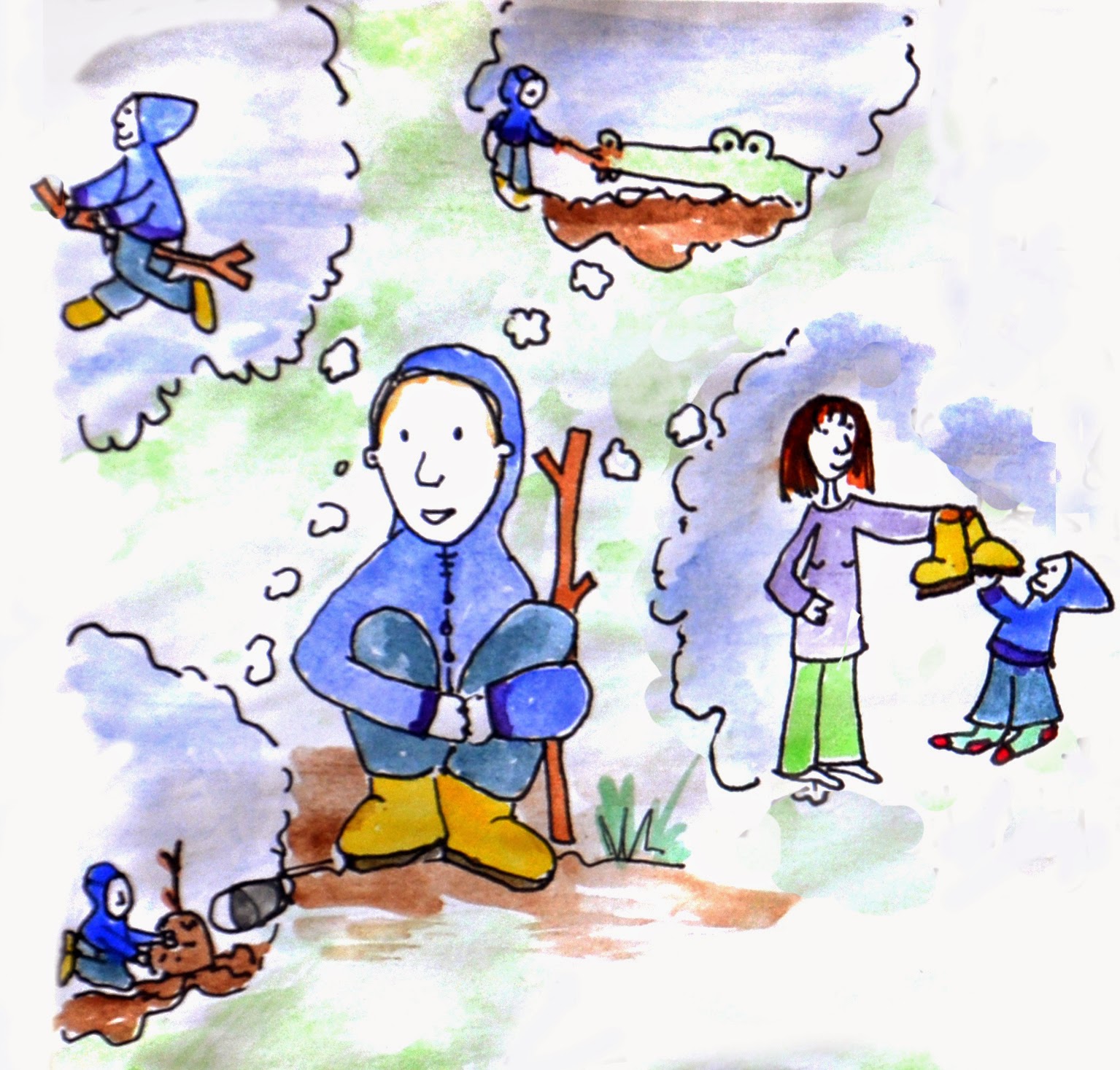

This is where the cycle connects. The exterior becomes interior and the flexibility becomes part of the child's way of being. The successful experiments suggest new ideas. The problem solving suggests a new goal.  The experience they have just encountered is added to the toolbox of the child's mind. The compounding aspect if this is that the more flexible the child is the more they see the flexibility in the environment.

Conversely a restricting attitude of the adult can shut down that extraordinary potential found in a flexible environment. The compound flexibility process can stagnate if conditions are unsuitable. Children who have little control over their world inevitably have fewer positive experiences, which in turn slows the development of their self confidence. Children who lack confidence are less likely to take risks or try out different solutions to the problems they encounter. Which makes them less flexible and responsive. 

I find that thinking about how these elements interconnect really helps me think about my role and the role of the environment that the children are in and reflect on how these two elements can combine with the child's experience to create powerful opportunities for development. 

Drawings taken from a doodle for the Forest School Association Newsletter Autumn 2014

Tuesday, 26 November 2013

Child led learning or how it feels to not be in charge

Giving control over content and intent of play and learning to children

Child-led learning sounds like it should be easy, just see what the children are interested in and excited by and then follow it. Actually, when you put it like that it is easy and in the context of outdoor learning  allowing the children to lead can be wonderfully simple to implement. There is so much to discover and interact with. It is hard NOT to be learning.  Where child led learning becomes more challenging is in the personal internal battles you face as a practitioner.

I am thinking for example about a time when a group of children decided they would have a ‘bug market’ where they could trade things with each other. They decided they could bring things from home, or trade conkers, interesting leaves and other found natural things.  They asked us to provide materials for signs, sheets to set things out on and they left the session really excited about the upcoming Bug Market.

It was only after they left that we started to realise the gaps we had left open, what sort of things would they bring from home? What were the ethics of trading live insects? Who would decide what trade was fair? How would we agree the rules?
One of the key lessons I have learnt over the years is to never imagine that I am in charge. It can be a real challenge to master my ego, not listen to the voice that says “Well, I know best because I am an adult.”  Or allow the part of me that already sees how this could go horribly wrong to be too dominant. 


When the children arrived for the Bug Market it seemed that the children had all understood what the rules were to be without me having to get them into a discussion. No-one brought their favourite toys to swap, you don’t have insects in a bug market, (and apparently I should have know this!) and the adult role seemed to be to keep currency moving around as more people wanted to be stall holders than to barter. 


But child led learning doesn't start the moment you decide to step back. When I walked into a woodland with a group of nursery children, most of whom had never been in a woodland before, it’s almost like they couldn't see the potential, and didn't know yet how to interact with it. It took a few sessions of going back to those same woods, with practitioners and staff providing encouragement and permission to the children to collect things they saw, asking them to describe their finds and to interact with them, to follow trails of feathers and touch mossy stumps and smooth leaves. Then the children started to notice and to lead. A long worm stopped us in our tracks as we walked up the path. The children are acutely observant, “it is coming towards me,” “now it is going to you,” “it is a letter C for Callum” “it feels sticky, like a fish” They put things in its path to see if that changes the direction it goes in.

When, during the following session we brought magnifying glasses and pictures of the minibeasts they could find they responded really positively and were quickly immersed and interested. Child-led learning can take time to emerge, as group dynamics settle and the children gain the confidence to lead and to believe their ideas will be listened to.  This is one of the reasons why effective outdoor learning takes place over time.


They start to see your role as a provider of resources, ideas, ways and means rather than the instructor, which can often run counter to the normal relationships they have with teachers and other adults.
The natural environment is an unpredictable place, you never know what you will find. You can plan and prepare for certain learning experiences to take place, and they may happen, but what you cannot plan for and only be receptive to, is the unexpected.


"In preparing for battle, I have always found that plans are useless, but planning is indispensable."
–General Dwight D. Eisenhower


Sometimes like with the Bug Market, the children are explicit about the direction they want to take, sometimes child-led learning comes about by following a particular line of questioning and sometimes an observation is the key. In the first week in the woods with another group, William picks up a sharp stone and uses it like a tool; another child watches him and copies, using a stick with the same motion. It occurs to me they are whittling. Even though I don’t usually bring tools in this soon, their behaviour intrigues me and I bring potato peelers for them to whittle with for the next session. 


Outdoor play and outdoor learning provide enough scope for each child to be following his or her own line of enquiry and for them to collaborate with other children and adults. But those internal battles I mentioned... how do you feel about how you are perceived in your role? Not by the children, but by other practitioners, visitors, parents and parent helpers, a passing head teacher or an Ofsted inspector. What happens when the lines of enquiry that the children choose to follow includes squishing living things, making weapons, having battles....? 

*This post, written by Lily, was originally published on forestschools.com in Oct 2010 and is republished here with their kind permission. 

Saturday, 25 February 2012

Comfort-Challenge-Fear

"So, what makes you feel comfortable?"
This was the question I asked a group of seven to nine year olds this week. We were in the woods for the first session of our Forest School sessions and I wanted to help focus them on what they would be doing over the next few weeks. Their answers were the sort of this you would expect, sitting on the sofa, laying in bed, being wrapped up in a cozy blanket. We feel comfortable when we are doing things that are easy and we have done them before. But that isn't why children take part in Forest Schools.


Forest School programmes are about more than spending time in the woods and exploring. They are also about encouraging children's motivation and helping to develop positive attitudes, stretching the children and helping them realise their skills. These things just don't happen when you stay in your comfort zone.

Challenge: moving out of your comfort zone
 but still being able to function
This was how I explained to the group; we would be coming to the woods for Forest School and this is to challenge them, to try new things and for them to find out things they didn't know they could do. It is important for the children to be challenged but at the same time making sure they don't feel pushed too far.


I've been thinking about this model for a while, it is in common parlance in adventure activity circles and leadership management but I don't normally share this sort of thinking directly with the children. I was talking with a friend Kirsty who is a youthworker about how she shares models like this with the young people and this is so simple I knew the seven to nine year olds could get it too. So we laid out the different elements and talked about how important it is to move out of your comfort zone. They got it straight away and I saw lots of self motivated behaviour.


Comfort zones are such a personal individual thing and this is where the most important challenge for these children will come from. The challenge they set themselves.


Sunday, 12 February 2012

Yes, and... Play and learning.

Sometimes I feel like describing ‘play’ is like drawing the wind. You can recognise it, you know what it looks and feels like, but it is somehow nebulous and hard to pin down. I have been working in the field of play and playwork for nearly fifteen years and yet I have still to find just one way to describe what play is. I love the fact that all you need is a handful of playworkers (and maybe a bottle of something) and ask, “What is play?” and they’ll be at it for hours!


A few weeks ago My friend Kirsty and I delivered a workshop for the Institute of Outdoor Learning on playfulness and flow states. We were exploring how an understanding of theories can help learners in a range of environments Looking for 

"Play' is a term employed in psychology and ethology to describe to a range of voluntaryintrinsically motivated activities normally associated with recreational pleasure and enjoyment”1


Which sums up the feeling we were trying to convey through our workshop, that children and young people get so much out of being able to direct their activities into something that holds their involvement, that it is important for children and adults too to be allowed to play. In recent years I have been doing more work in formal learning environments and I really see the value of the spirit of playfulness I bring to the work I do. The aspect of play or playfulness that really appeals to me, especially when I was considering how it motivates and engages learners, is the state of immersion and engagement that a child at play can enter, when the real world is lost to them and they understand totally what the rules are. Even if there are other agendas that the teachers or facilitators are trying to manage, there are still benefits to following the children into that zone, that place of immersion.


I heard a comedian talking about improvisational comedy and  he was saying how improv can be made to work if the people taking part in it follow the rule of “Yes! and....” basically, if you take whatever is offered and try to build on then you get to a more interesting, and in their case funny and surreal, place. That really strikes a chord! I know from my own teaching, training and playing that when something comes up from the group you have two choices, one is to try and shut it down and bring people back. The other is to accept what is offered, “Yes! and....” to go with the new direction. Let things come back to the starting point naturally and allow people feel more included and involved with what they are learning. Even when there is a very specific outcome you can still get to the same end point by following the meanders that include other people’s ideas rather than sticking only with your own route.

Playfulness for me is about being responsive and flexible, embracing the unpredictable nature of the world and the people in it. What do play and playfulness mean to you? 

Monday, 1 August 2011

Learning as much in an hour of play....

"You can discover more about a person in an hour of play than in a year of conversation." 
 
Plato


I recently spent a wonderful 24hrs with my friend and her daughter, my goddaughter R. Now aged six, this is a child I have known since before she was born, we lived all together for a brief time when she was a baby. I met her mum met at a nature play conference and we worked together for a bit and have been friends for years. We get to meet up too rarely as we now live 250 miles apart. But the reason why I am telling you this is because in that short visit I experienced the most extraordinary hour of play.

In the course of my work I observe children at play and play alongside children a lot. Children playing together often talk and discuss the narrative of the frame in which the play is taking place "You are the dog and I am the mum and then the mum says to the baby, so you have to be the baby but I'm still the mum" sort of conversations.

As an adult invited into that play frame, or, as often happens when I take children into the woods, when I am trying to help children establish a play frame in an unfamiliar environment, a lot of talk can take place. I make observations of what is happening, the child shows me what they are doing, they ask for feedback, ask questions, try to work out the boundaries. This is all part of the containment process, of helping children maintain a play frame.

In this most extraordinary hour of play, the most extraordinary feature was that it was almost entirely silent.

My friend had to go and work for a couple of hours so I offered to look after R. There were a number of options for the morning but R said we should stay at the house and go to play in the little strip of woodland next door. We got up in the morning and my friend went to work. R did a little test of the boundaries.
 "I want to watch a programme."
 "Ha! the only way we are going to watch TV this morning is if we make the programme ourselves....Oooh actually, we COULD make a TV programme, I have my camera."
"WE could make some TV? "
So we did. R telling stories and singing for the camera, then we went out into the woods and she made a documentary on how to collect things.

As we were heading back into the house I spotted the stalks on a particular sycamore tree were really long and I pointed them out to R. This was our shared  play cue, she collected a few leaves and started winding them together, I collected a few and threaded them into a long chain. During this I offered the usual sort of statements and observations I might with a child when I was working; "You have threaded three leaves together, I think I might hang mine on this tree." Looking for ways we might extend the play frame, But I noticed that R didn't seem to need these and I stopped.


Which gave me an opportunity; I have for a while now had in mind to try and make a geometric cube from leaves. I draw much inspiration from the work of Andy Goldsworthy and as a teenager I saw one of his leafworks boxes in a gallery in the city where I lived. Ever since I had in mind to try and make one. The impetus for which came right back when I recently found one made by another land artist. I've already made one attempt which was a really useful learning process, but the thought of doing something that required so much concentration and time seemed counter intuitive when I was spending time with a lively six year old.


The level of absorption she showed made me loathe to be the one to break it. And we played in parallel she and I. Both in such a state of flow  and absorption I am still unsure how much time passed.


We spoke very little each very focused in the challenges we had set ourselves.


Occasionally delighting when something worked well.


Allow the ideas of the other to inspire us in our own play.


Stretching ourselves.


Making observations.


Until we reached a point at which the possibilities had all revealed themselves for now. R made an observation. "The dry leaves are just as good but the brown ones are two crispy."  I had made five corners of the box but run out of suitable leaves.


We collected some bits to take back to the house and moved on. The frame which had held us in a state of flow was gone. Naturally extinguished.

I felt as if in that hour of play that I had got to know R in a way that all the phone calls and letters had never revealed. I saw her deep level of ease at being outdoors in nature. I saw how dexterous and creative she is. I saw how motivated and self contained she can be. She saw me too. I explained to her how much I had enjoyed being  in the woods with a child who didn't need talking to all the time and that some children I worked with needed my help a lot more. "So is playing your job?" she asked  "You are good at playing."


Terms used in the description of the play process have been taken from The Colorado Paper by Gordon Sturrock and Perry Else 1998, P8 onwards. 

Monday, 13 June 2011

Making Weapons and Group Agreements

I am, by nature a peaceful sort. However I often find myself building and making weapons. I do like the satisfaction of seeing a stick shooting off into the distance fired by a home made bow and we have made some constructions (that could best be described as siege engines!) that would fire pebble a good distance.


I have written before about the theory of recapitulative play and I feel that weapon making fits alongside fire making and shelter building. In the regular, day to day life of the average 21st century child in a developed country these are skills that have very little practical application. But there is something about them that has such a strong impulse and compulsion for children (and adults). 


I also feel it is important to allow children to explore this compulsion, especially when we live in a world where children are exposed to so many images of war. Through play a child learns to make sense of the world they experience and inhabit, so there is a value of them being able to 'play it out'. However this sort of play can upset or even hurt other children so needs to be carefully observed and managed.


Making bows and arrow sets is one of those things that I rarely introduce deliberately into my sessions but I respond to with glee if it emerges with a group. It is great for self esteem and children feel powerful and trusted being allowed to have a bow and arrow. I wrote an article about dynamic risk management recently. When something like this emerges in a session I feel it is important to be able to respond and reset some new rules and conditions For me it means you get to establish rules with one or two children and support them a lot. Another sees what we are doing and joins in, we repeat the rules we have come up with, repeat ad infinitum, so by the time the whole group is involved (if they are) we all know the rules intimately. That way it is easier than me banging on about safety, as they are having to do that themselves, for each other. 


I aim for bow and arrow sets with an element of built in obsolescence. That gets us round the inevitable question of 'are they allowed to take them home?' which wouldn't be appropriate in some instances. Beyond that on the most basic level you can get a stick that is just slightly thicker than your thumb and about the length of your arm and has some flex in it and a piece of string. Trying different string to see which works best is a good exploration of materials. Whittling a notch in the end of the stick stops the string sliding off The string is tied to one end and then that end is placed to the ground and the stick is bent as much as you can before tying the other end of the string onto the stick. The stick bends back into place putting the tension on to the string. This will then fire another straight-ish stick, which you can whittle a bit to make a point, a reasonable distance. Holding and pulling back the arrow stick rather than the string is easier for some kids to manipulate.


Setting group agreements on safety normally starts with me trying the first made bow (and hopefully getting it into the long grass a good 15- 20 feet away followed by a bit of woooah from everyone, including me.) Before I hand it over i say, "This comes with responsibility. What do you think the rules are?" I then go with every safety rule than seems logical and we agree those. As a minimum I look for firing away from people or animals, or firing at a target if there is a bigger group. The ideas they come up with might include shouting "ready-aim-fire" so people know you are firing and don't walk into the line of fire, shooting out of the boundary that normally applies but being allowed out to fetch arrows, watching out for people walking through the woods if it is a public wood. 


The trickiest point comes if you have a target and people want collect arrows whilst other people are firing. So getting them to put a system in place is important. (Flag up for fire, flag down for collect / Having an adult say when you can collect) 


By establishing the rules by collective agreement the children are no longer passive participants in their own safety and well-being. They are actively identifying the risks, thinking of solutions and most importantly reminding each other and me. I used to try and spend time at the start of sessions getting all the ground rules in place that would last us for the rest of time. Children would be bored and fidgety, they found it hard to imagine the situation let alone understand the potential ways that rules should apply and would just repeat the rules they had had drilled in to them elsewhere. The point when a child who was asked what they thought the rules should be for a session in the woods said "no running" was when I realised, they were on 'ground rule autopilot'! Now I rely on spontaneous group agreements that respond to the situation we are in. It starts from the assumption children know what to do and works forward into the new situation.
Targets with bells on. 
Set up to respond to a group who loved throwing stones
With bows and arrows or any made weapon in Forest school, I always add my own rule. Once we have agreed the rules I get to claim the weapon as my own for ever and ever if a rule gets broken. I very rarely need to use my rule.

Sunday, 20 February 2011

Recapitulative play, (we get our fire ready for cooking)

In a recent post a new provocation came from the children. My job when I am in this particular school is to follow the children's lead and extend their ideas. This can be really exciting, especially as it is a large foundation stage with 100+ three to five year-olds. 
I was talking to my friend Jen about the new provocation and how the children had started off making a pretend fire with sticks. One child started rubbing sticks together to make fire and the others all copied. Because rubbing sticks together is how you make fire right? 
Well yes, it was until some bright spark invented the friction match in 1827, and before that in the 17th century there were chemical spark makers, but as Jen and I were talking we realised that more often than not when you see children playing at lighting imaginary fires, they rub sticks together. 


As often happens when you get two playworkers in a room we started hypothesising as to why this should be.  Bob Hughes in is Taxonomy of Play Types(1) puts forward the notion of Recapitulative Play – "Play that allows the child to explore ancestry, history, rituals, stories, rhymes, fire and darkness. Enables children to access play of earlier human evolutionary stages." 

Through play children displays aspects of human evolutionary history that have been stored and passed on through the genes or shared memory and these emerge when children play spontaneously. When children play they are reflecting the things that children throughout history would have done as part of their learning to become an adult member of society. It contributes to the explanation of why den building and shelter making are always so popular and why children like to a play with sticks, transforming them into weapons like spears and bows and arrows. None of these are important skills for life in the 21st Century but they have a powerful pull on the mind of a child. 

The ritual aspect of children play is also an important element of recapitulative play. I remember years ago lighting a cooking fire with a group of children and them spontaneously forming a ritual dance and chant to help the fire light burn brighter. 

cooking popcorn
I'm sure there are lots of cartoons and other representations that would explain why children rub sticks together to make fire. But they see matches, lighters, and cookers with  ignition buttons being used more commonly and I can't think of a time when I have seen children role playing fire lighting in these ways. 

So having found a starting point from the children's play I was thinking of directions we could extend. So the next day that I was in school I brought a fire drill and fire flash with me figuring that the rubbing of things together to make fire was an important element in the play that we could develop into their learning. 

Trying to make the fire machine (bow drill) work

They were fascinated by the fire drill and called it a fire machine but despite us taking a lot of time and care, working together very well as a team there are just too many elements for a group of 4 and 5 year-olds to coordinate. The fire flashes (we call them dragon sneezes) were much more successful. The sparks we made encouraged the idea that we able to make real fire. Which led really well into talking about how we were going to stay safe.

Because the setting is so large and all the children are able to flow freely in and out, I was wondering how having a real fire would work. I felt like I wanted to be able to concentrate 100% on the children and their reactions. So when I found a stash of portable barbecues I felt this would be an excellent way to introduce the  children to fire and focus on our safety rather than having to think about the fire too. It amazed me how, as more and more children were drawn over to the fire area they sat down and chose to stay sitting there, others told them how to behave and they were incredibly respectful and didn't try to push the boundaries at all. Two boys brought drums out and we had some wonderful renditions of their favourite songs (currently 'down in the jungle' and 'little rabbit foo foo') whilst we cooked up bowl after bowl of popcorn. 


So whilst there is some  controversy over the years about including Recapitulative play in the list of  play types (it is left off of some lists entirely) it addresses forms of play and powerful urges to play in ways not found elsewhere.

(1) Bob Hughes, published in full in ‘A playworker’s Taxonomy of Play Types’ 
(PLAYLINK, second edition 2002)

Monday, 29 November 2010

The builders take a break

As the children had their lunch I went up to the treehouse site (if you are new to this project then catch up here and here). I wanted to check things over and see what things looked like without half a dozen small bodies on top of the walls and door frame. A group of girls came out after their lunch and watching them playing in the treehouse distracted me so I didn't get a chance to get any tools out. As more and more children arrived they climbed up and over the walls, which being made from pallets are like ladders.

It wasn't long before the first person tried an experimental leap.


There are a number of blue crash mats in the garden and a teacher and I dragged them over to the treehouse. Another child leapt, then another.


What fascinated me is the play behaviours that I observed in these children, who are aged four and five were identical to the play that takes place on self-build adventure playgrounds. I spent some time as manager of an adventure playground and this sort of deep play was common. Deep play, is defined by Bob Hughes in his  book A Playworkers Taxonomy of Play Types, 1996 London, PLAYLINK, UK  as  play which allows the child to encounter risky or even potentially life threatening experiences, to develop survival skills and conquer fear. 
There is a view that this sort of play is uncommon in  the early years stage but there was nothing that I could perceive that distinguished this from the play behaviours of  much older children. For some they were truly overcoming some deep fears and apprehension, their trepidation palpable as they climbed for the first time and stood on the top of the pallet. Others, seeing another child leap, were straight up and over, crashing into the mat. Some would jump from a sitting position. Each child, assessing, choosing and managing their own level of risk taking. Their confidence building with each turn they leapt again and again.


One boy was desperate to be part of the leaping but his fears kept overcoming him. He would climb on the pallet, getting higher each time before deciding it was too high, climbing down and coming to lean against me. I tried to help him recognise the achievement of climbing to the top and the teacher encouraged him to try jumping from a sitting position, as others were. He climbed again but didn't jump, instead he chose to swing down on the door frame. For him this was a challenge as great as leaping in the air from the top of the pallet. What constitutes deep play will always be different for every child. He reminded me of a group of boys at the Adventure Playground who built a jumping tower with platforms at different heights. One boy was involved in leaping from the lower platforms for a whole week before he climbed to the top platform. He must have spent over an hour waiting on that platform watching his friends before he felt ready. Once he had made that first leap he had overcome that fear and jumped again and again. 


What I really love about working alongside the teachers and children in this particular setting is their acceptance of the children's desire to take risks. Perry Else in his book The Value of Play, London, Continuum books 2009,  says
"The aim of deep play is not really to die but to experience the thrill of close encounter, letting us know we are fully alive and so helping us conquer our fears. Quite often when adults see children engaged in deep play they may feel compelled to intervene to keep the child safe. This then results in children who may feel unable to take risks on their own terms. We need to understand that taking risks is helpful to children in building up their resilience to the challenges of the world."

The role of the teacher and I was to make sure everyone did take any risk on their own terms, that no one felt physically or emotionally pressured to do a jump they didn't want to do. Some children watched or stood at the top of the pallet for quite sometime before they decided to leap or climb back down. With a press of bodies behind waiting for a turn it could be a challenge to give each child the space and time to decide how and what they wanted to do.


The addition of a heap of cloaks deepened the role play element of the leaping as batman, 'wonder-super-hero-girl', Ben-10, and Buzz Lightyear leaped onto the crash mats. One child's play was in the role of Ben-10 (a cartoon boy who transforms into a super-hero alien) Each leap he made was prefixed with a complex summoning of elemental forces. The control and concentration on his face reminded me of a tai chi master, so deep was his level of immersion, the stillness and control in each of his actions. 


Over the course of the afternoon they leapt, leapt and leapt again, there never seemed to be a break in the flow of children.

When I got home that night I picked up the book I was reading, which is a book of articles by the writer Tom Robbins. In this book I came across the word 'approfondement'. Robbins describes it as "a marvelous French word which roughly translates "as playing easily in the deep". That's how the afternoon had seemed, like we were playing easily in the deep.


.

Thursday, 14 October 2010

Play is like breathing

I have searched the whole internet to see if this has been posted anywhere else and it hasn't. It isn't mine, I can claim nothing but having found this a few years back and saved it. I would love to credit "Jacky" so if that's you, or you know who it is then give me a shout. But this is too good not to share:

"I'm not sure if this is going to play out but here goes - Is play linked to present wellbeing or to future development?

 If we use the analogy of breathing, (both play and breathing being natural human processes?) we can see that we need oxygen to live both from day to day and to grow and develop. Our bodies are designed to get oxygen through breathing. Most people breathe without assistance and we are not taught to breathe it just happens. The more freely we breathe the better we feel. Had we not evolved to breathe we would not be here in our present form now. Without breathing we do not live. 

Our breathing changes automatically in relation to the personal and environmental circumstances it finds itself in, e.g. when we run we breathe more heavily to get more oxygen; if there is a lack of oxygen we breathe in a laboured way; when we are relaxed we breathe more slowly and deeply; if the air is polluted we breathe in some of the wrong stuff etc. In some circumstances we need intervention to help us breathe. The interventions can be minor - olbas oil on the pillow to help with a stuffed up nose; regular - inhaler for an asthmatic; ongoing - oxygen for someone whose lungs have collapsed; or major - full on mouth to mouth resucitation when somebody has stopped breathing. We can be helped with techniques to breathe if we are either having problems or if we wish to control our breathing more effectively, e.g. breathing in and out of a brown paper bag if we are hyperventilating, or becoming very aware of our breathing for meditating. From this we can see that breathing is the stuff of life past, present and future. Most of the time it happens automatically and without interference, but sometimes there is a need for intervention.

Play is also the stuff of life. We are designed to play. It happens automatically and it changes in relation to our own personal needs and circumstances. We need all the immediate benefits that play gives us as part of the process of playing. Had there been no playing in the past we would not be who we are now. If we do not play we are not emotionally healthy, we  do not live effectively and we do not develop fully. The environment can have an effect on the quality of the play that we do and sometimes we need intervention to help us have better play experiences both for the here and now and for the future. These interventions can be minor - a look to show that it's OK; regular - an after school club for children;  ongoing - wonderful props and places for play and friends; or major - play therapy, depending upon the circumstances. Sometimes we want other people to intervene in our play or we recognise that we need assistance. Other times somebody, other than ourselves, sees that we need help.

Now here is my point. Play is linked to our past, present and  future just as breathing is. Intervention is needed when people are having difficulty breathing and this should be appropriate to the problem. Generally healthy people either breathe automatically or they can control their own breathing. Generally children control their own playing and intervention is only needed when there is a problem or if the child invites it. The intervention then needs to match the circumstances. We do not resucitate somebody who has a snuffly nose, neither do we use olbas oil to cure a collapsed lung. The problem with intervention into play is that for too long in recent years when the rhetoric of play as progress has been the dominant one and formal education has been seen to be the only way to help children develop, we have been using the equivalent of play resucitation on perfectly healthy children when no intervention was needed, or at the most a bit of olbas in the environment might have improved the atmosphere!

I would say that of course play is linked to development, but this is not the only thing it is linked to, and there is a real danger in thinking this, if we think that we can in some way become responsible for how it plays out in the individual child.  If we intervene inappropriately we may well do more harm than good, or at very least we may be being completely ineffectual and not recognise the fact. A large majority of children need no form of intervention for their playing to be part of their natural healthy development. They will play and they will develop. However there are circumstances when some children do need intervention in their play and this may be needed just for the here and now and/or for the health of their ongoing development.

I wait with baited 'breath'     Jacky"

comment FB

LinkWithin

Related Posts Plugin for WordPress, Blogger...

LinkWithin

Related Posts Plugin for WordPress, Blogger...