Showing posts with label Deep play. Show all posts

Thursday, 14 August 2014

What happens after you feel the fear?

I didn't know how much of this last week would be spent dealing with fear. Heights, the dark, spiders in the toilet, bigger kids. All normal parts of a week of play in a field on the edge of a wood. But what struck me again and again is the resilience and bravery of children who know they are afraid but refuse to let that get in the way of experience. 
Jerry Hyde says there are some books which you only need to read, because it's all in the title; Feel the Fear and Do it Anyway. That sort of thing...
Choosing the forty foot tree swing, walking out in the dark, becoming so fascinated by the fact the spider has babies that you get over your fear and look through a hand lens. The tales of bravery I could tell you, and that's just one week.


It's normal to feel fear. It's part of what keeps us safe. It's part of moving out of your comfort zone. A way, as I've explored before here, to help children (or anyone) move out towards those fears that won't case harm and to still feel safe is to help them see it as a challenge and to play with the idea. You can't simply tell someone not to be afraid. Something has to replace the fear. 
We stepped out of the field, over the fence and into the dark dark woods at night. Nate said; "I'm scared!"
What of? I asked.  "Everything." replied the tiniest voice. Are you afraid of the clouds? I asked. "Yes." Are you afraid of kittens? "Yes" said a slightly bigger voice. Are you afraid of fluffy blankets? "Yes!"  ...of baby chicks?
"Yes!!" said Nate. "I want to hold Elliot's hand."
 Are you afraid of holding Elliot's hand? I asked "oh yes" Nate laughed and took Elliot's hand. 
Sometimes it's a challenge to remember why you were afraid before. 


Fear is an OK thing to feel, I tried hard to let the children know that it was OK and a normal thing for them to feel. The bodies way of dealing with fear is cortisol. The chemical trickle that, if turned into a flood will lead to a fight, a freeze or a flee. This stress response in it's trickle state gives us the adrenalised state of full attention, real curiosity and the learning sweet spot that comes with it. Too much adrenaline and the flood turns into a punch and kick, or a run from the scene. Or a shutting down, and a blacking out. Poppy's stress response is so extreme that she starts to black out if things get too noisy or busy or crowded around her. The doctors are still trying to work it out, but age 11 she manages it well, preparing an adult to take responsibility and notice the signs. Coming over and tugging a sleeve when she feels it start. Yet, the need to feel the fear and do it anyway is so strong she pleaded to be included "will I be still able to  go on the swing and the night walk even though I have my head thing? Pleeeeeeeease" she refused to let anyone suggest she was not up for it.


Clipped onto the swing and ready for her first attempt I could hear her rationalising under her breath; "my friend did it... all I have to do is is is is... if I step off here where will I go... and what if what if? So we talked about the special kind of fear that comes before you do something really cool and really safe and how that gives you an even more special kind of feeling afterwards. The feelings you have when you have overcome a challenge. "OK ready" she said and let herself go into a wild swing with a scream that could be heard across the valley. It ended in laughter. "I'm totally doing that again." 

Bob Hughes in his Taxonomy of Play Types uses the phrase; Deep Play. It's one of the hard play types to describe, yet whenever I have helped people unpack the play types and we talk about deep play, "you know that sensation when you do something tricky and you feel it right here, under your ribcage. That's deep play." Everyone nods we all know that feeling, from balancing on a wall and wobbling just a little, from climbing a tree and losing a foothold, even standing on a stage and preparing to sing or take part in a play. It's different for everyone. Your deep play could be my everyday experience. My deep play could be your relaxation. The Swedes have a saying about that feeling; occasionally you have to feel the ice in your stomach if you are to feel alive.

Friday, 25 April 2014

‘I climbed right up to here’ or Risk and Challenge in a Forest School


Risk taking is widely understood to be a natural part of a child’s development. Adults who work with children are moving on from thinking of risk only in the context of ‘the risk assessment’ which decides those things are too dangerous to allow. But are rather looking at risk from a child’s point of view, making an analysis of the risks and the benefits to create a Risk Benefit Analysis (RBA). Risks and risk taking is even better understood when re-framed as challenges. Providing realistic challenges for children and allowing them to work through the challenges they set themselves supports their development, actively engages them and helps them better understand themselves and each other.


I am always fascinated to watch groups of children climbing trees. I remember years ago working with a little girl who was very risk averse, very challenge averse. She was part of a group of voracious tree climbers and she would watch them, anxiously reporting to the adults just how high the others were climbing. One day she stood on the lowest branch and, reaching up, tied a string on the trunk. Each week she would climb up and touch that string, until one day she felt ready to reach higher. She stood on a different branch and moved the string further up the trunk.
Recently I went out with a Forest School group who had been coming to the woods since the previous summer. They still climbed to the same height limits that we had set together months previously. But there was a change in the amount of support they required from the adults present. It had started with our active support and encouragement when they wanted to climb, more often than not we would talk them down when they climbed out of their comfort zone. This moved on to them needing our presence nearby, just in case, to the point where now they were climbing and moving around with ease. One of their classmates, who had not previously been out to the woods with us, joined in the tree climbing. Within moments had climbed higher, on different trees in a very different way, shinning up the trunk rather than climbing branch to branch, wedging himself comfortably, literally out on a limb.


Children’s responses to risk taking are as diverse as the children themselves.  Douglas & Wildavsky (1982) have suggested that there are four kinds of people when it comes to managing risk: Hierarchists, egalitarians, individualists and fatalists. Mark Gladwin (2005)1 linked these different types of risk takers to the observations he made of children at play. You may recognise these types of risk takers in the children you know and work with.
Hierachists are those people who will naturally follow the rules, who deal with risk by following the procedures. If these procedures stress safety above all then these people are unlikely to find ways to push themselves out of the comfort zone. These are the children that look to you for permission before testing themselves and conform to set parameters, like the little girl and her string.
Egalitarians have strong group identification and emphasise group solidarity at the expense of official rules. These children, like the group I was watching climb trees had developed a group norm. They had set parameters for themselves as a group and no one person in that group was likely to engage in risk taking behaviour that didn’t conform.
Individualists are independent-minded and able to defy official rules and group pressures to make their own decisions on risk management.  Like the boy who joined the tree climbing group but went out on a limb, individualist children are the likeliest to engage in risk-taking of the kind described by Hughes (2001) as “deep play”.
Fatalists are those people who submit passively to external control without commitment to group norms or solidarity and take no steps to either avoid risk or manage it.  These children are the hardest to predict how they will respond to a risky situation. I wonder if their response to risk is borne out of inexperience in risky situations. Sue Palmer (Toxic Childhood 2006) says “All real children’s play involves an element of risk, and the more real play children are allowed the better they become at analyzing and managing those risks. If, on the other hand, adults try to eliminate risk from their lives they’re likely to grow up either unduly reckless or hopelessly timid.”

By observing the children we work with and understanding their approach, our response to their risk taking can become more informed. The risks we all take as humans take are not only physical but are social and emotional.  Forest School gives lots of opportunities for risk taking and challenge. For some children just being in woodland, especially if it this is an unfamiliar environment, is an emotional challenge. The opportunity to climb, move tree trunks, run on rough terrain etc provides endless physical challenges. Using tools and being around fire provides opportunity for physical and emotional challenges for children. Being in a group without the structure of a classroom and having to communicate with others, talking with a partner when using a saw to cut wood provides social, physical and emotional challenges. When someone overcomes a challenge, be it one that is set by ourselves or by others and we are given chance to reflect on how we feel, we offer the opportunity to build those critical qualities of self worth and resilience.


It is too easy under the guise of health and safety to try and remove the risks and therefore take away any challenge in the activity or environment for the children and it is worth noting that the child’s need for having a challenge, if not met, will often express itself in other ways including what we call ‘challenging behaviour’. The importance of a Forest school activity is in providing children the opportunity to take risks and build their self-confidence.

 “Most psychiatrists agree that mental health in adulthood springs from a successful weaning of the child from its parents, an ability to deal with the outside world confidently, without overdue dependence on adults. And making good relationships can only come with practice. Through unstructured play with others, children can work through their emotions and discover their identity.
If they are never free from adult supervision, they cannot internalise a parental voice or find a way of setting their own boundaries. They have no chance to do mildly dangerous things and find out how risks should be judged. They cannot chart their own course through the minor hazards of everyday life. Nor can they explore the real bonds of friendship and loyalty that are formed through common adventures with others their own age.”
(Sieghart, M. A. in the Times, 5 th August 1995)

References:

1 Playwords (Summer 2005 - Issue 26)

*This post, written by Lily, was originally published on Outdoor Play and Learning.com  in March 2011 and is republished here with their kind permission. 

Tuesday, 30 October 2012

Bridge that gap

I've written before about building rope bridges among the trees and how fantastic they are for children's motor development, encouraging social skills and confidence and being loads of fun.

What I have also found is that adults who work with children are equally as fascinated and enjoy learning the skills of tying the knots. I thought I would leave some notes here for a refresher for anyone who needs it (you know who you are :) and to maybe inspire you to have a try at tying rope bridges if you haven't yet.


I'll put in links to animated knot videos and drawings to help you along if you need it, but here's the thing about knots, some people learn by watching, some people learn by listening, some just have to have a bit of string and be shown. That's the way different people learn and it doesn't mean one way is better.

Trees:  you want to tie ropes from trees that are solid and secure. Give them a good look over, lean against them and look up noticing if they move too much when you put weight against them. Check there are no dead branches in the crown of the tree that could show a weakness or cause problems. Choose trees that are a good size, not so massive that all your rope gets used up tying on to them but big enough.

Protection: If you are going to leave them up and the tree are smooth skinned like beech or young ash trees etc then put something like carpet or thick fabric under the ropes to protect the bark.


Rope: I use 10ml (or thicker) polyprop rope. It's that cheapish blue stuff. Climbing rope can be too stretchy unless you have static climbing rope.
For length go for two pieces that are as long as a piece of string (!). Mine are about 10 metres each.

Once the children are interested in the idea I encourage them to be fully involved in tying the bridges, taking over completely after the first couple of times with my help. The older children tend to make them more challenging, going up slopes or with non-parallel lines.


Tying the knots: First end is wrapped around the tree three or four times. Tie with a couple of half hitches. The turns around the tree take the pressure off the knot

Wrap the second end of the rope around another tree, leaving a long long tail. go around the tree once and pull it tight "heave, heave etc",  I love getting the children involved at this stage, it takes much longer this way but is so much more fun and they definitely use the bridges more if they have built them.

The working end of the rope then goes over the top of the standing end and back round the tree in the opposite direction.
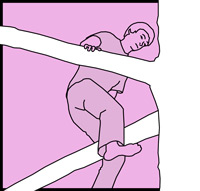
This is quite heard to type how to do this bit, so I have done a couple of doodles that may (or may not) help.


This end of the rope is tied to another tree.
                     This end of the rope is doing all the work.


Repeat this 3-4 times so the rope is pulled tighter each time.


The zig zagging of each turn, pulled really tight, with more of the "heave, heave" shortens the rope. It is this which pulls it tight.


With the end of the rope, wrap it round and round in a twizzly timber hitch. This stops it over-tightening and is why you need to make sure you have a long long tail on your rope. If you haven't got a long end on the rope then a couple of half hitches works well but can get a bit fiddly to untie


Repeat with the second rope, about a child's height above the first rope. They don't need to be far of the ground to be challenging and the wobbliness adds to the physical challenge.                                                      


Let me know how you get on! 


Thursday, 11 October 2012

Reflections on moving from survival to thrival

I have recently come back from a month long trip deep into the wilderness in NW Ontario, Canada. Which almost explains how quiet I have been here recently. It has been a lot to process.

I have talked before about how I the work I do encourages children to challenge themselves and as an adult who supports that then I should be doing the same. But this trip was more than personal challenge (although there were days like that) It was an opportunity to deeply immerse ourselves in nature, to take things at our own pace for weeks at a time and to adjust our rhythms to those of the world rather than the clock.

Sunrise from our camp on West bay.
Photo Tim Rowe

My partner and I packed three weeks worth of food into our packs, travelled to a remote little outfitting town just north of the Quetico Wilderness Park where we picked up a canoe and then quietly slipped off into the woods and lakes for three weeks paddling, portaging and a change of pace. It's the second time we have been to the boundary waters wilderness and with over a million acres of lakes and forest with no roads or houses, there is a lot to take in.

The view from under the canoe, walking a portage trail between two lakes.
Photo Tim Rowe

This trip was different though, I was trying to explain it to a friend and said "we moved from survival to thrival" I had made up a new word, I admit it. But that sense of moving from just coping and surviving to something greater, I needed a word that described a concept just right. As with all the best things I found that someone else had also come to the same realisation.

Early morning paddling. My partner makes these paddles.

One of the key things for me that felt different was our desire to create and how much time we gave to making things. Carving a sculpture from an interesting bit of firewood, making a spoon from a beaver felled greenwood branch, baking... lots of baking, fresh bread and cake every few days and firing our own pottery.

Carving a spoon

We had been told to watch out for one particular trail between two lakes as it was deep clay and it becomes very difficult to walk across if it has been raining. Inspired by sculptures we had seen in the Museum of Inuit Art in Toronto the thought of a cache of deep clay lured us in that direction.

Digging clay from the side of a trail


Shaping the clay

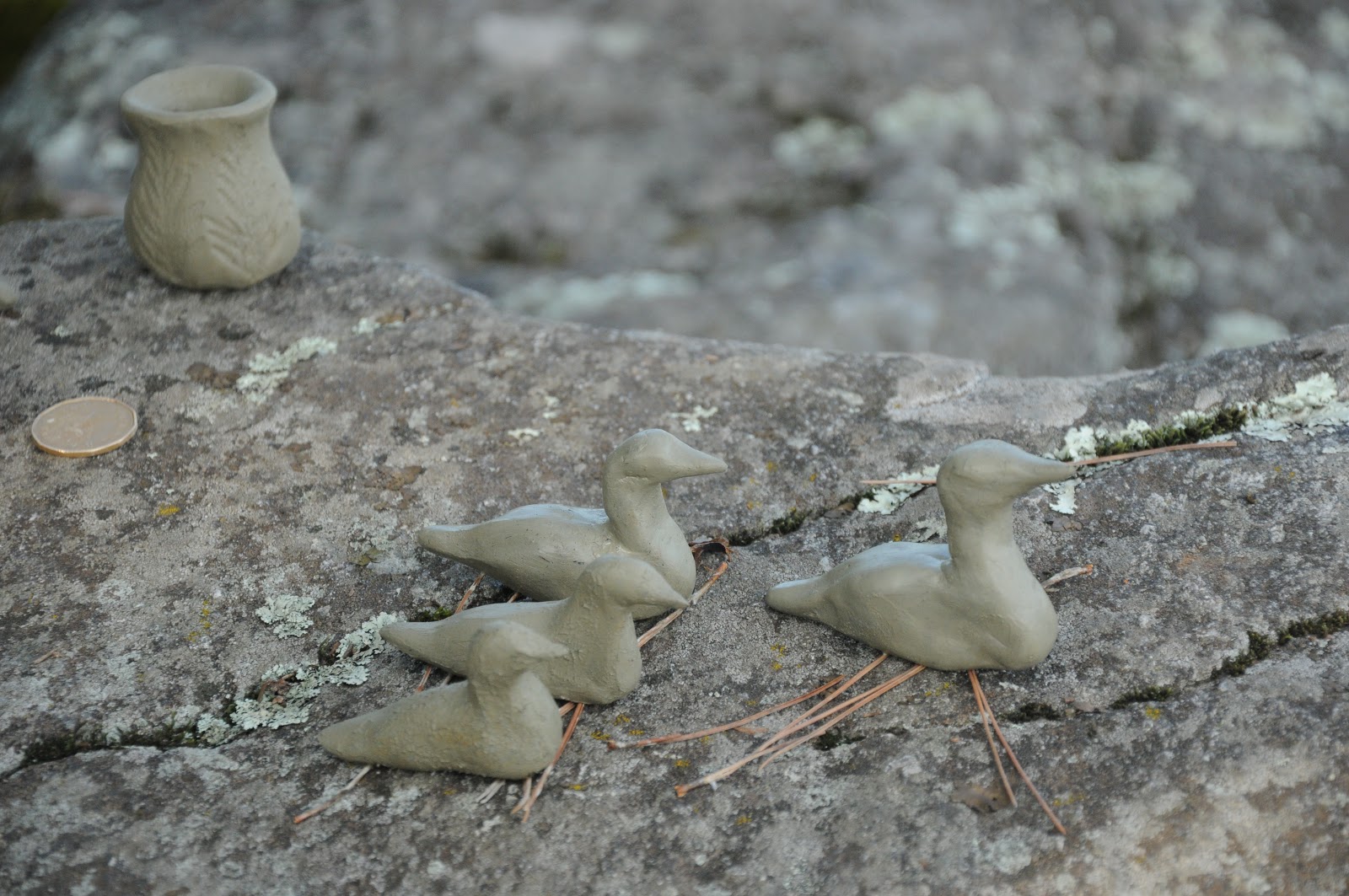
These birds were based on the loons that were often found
swimming around us on the lakes
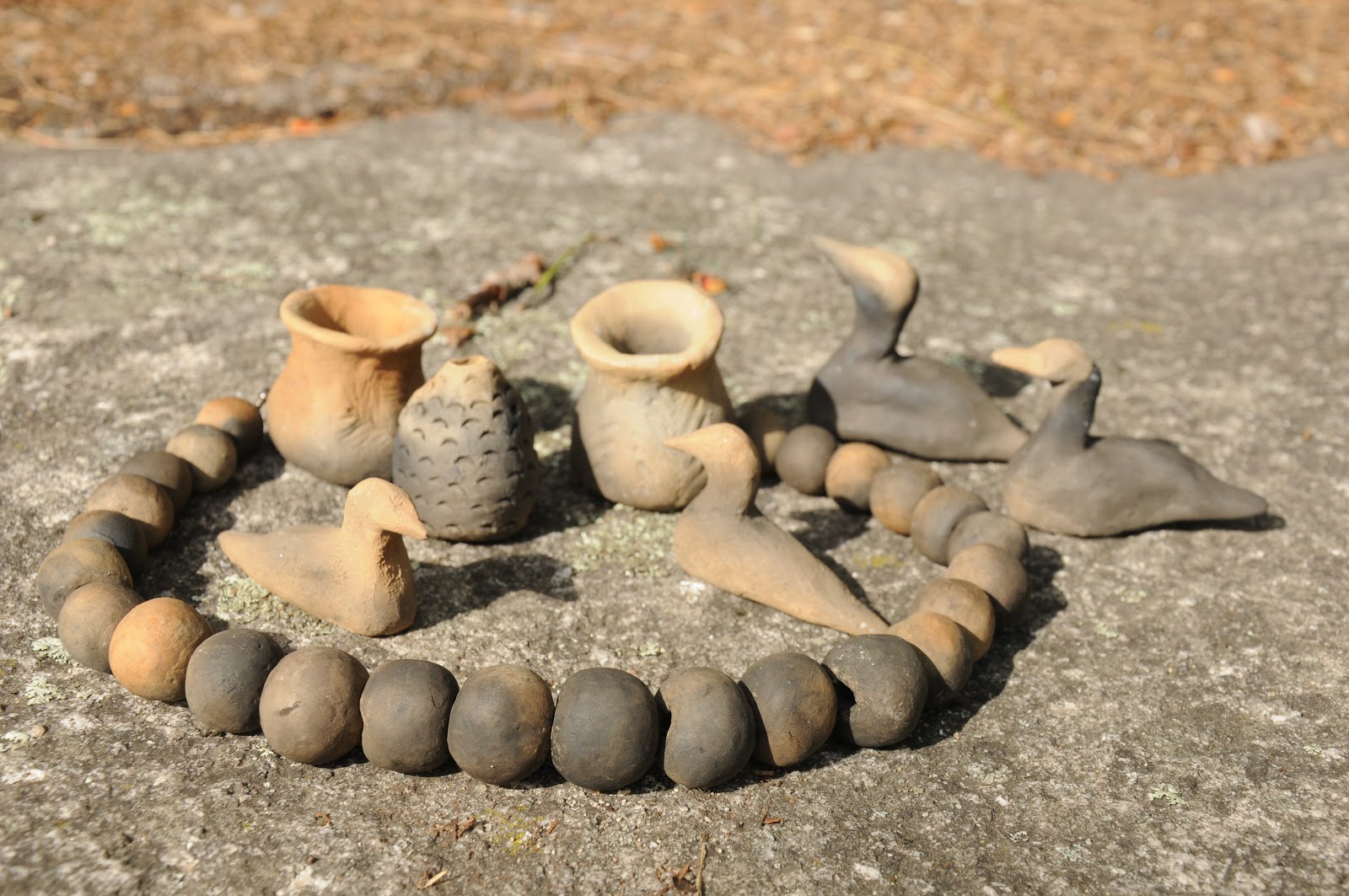
I have read quite a lot about pit kiln firing and tried a few experiments but we didn't want to make the impact in the environment of digging a pit. So we gradually heated the dried clay things by the fire, bringing them closer and closer to the ember bed, then putting them in the embers. This took about half and hour.


First we added fine twigs and pine needles to the embers to bring the level of heat and cover the clay things, adding bigger and bigger twigs until they were covered and a small fire was burning. 

We added larger pine, birch and conifer twigs until the fire burned really hot. This took another half hour or so and even though the temptation and the heat was unbearable we kept the fire burning at a high temperature for another half an hour. We could see everything glowing red in the fire. Despite wanting to peek we let everything cool down slowly before raking the coals aside to reveal our hoard.
Uncovering the fired clay

Our haul of clay fired goods
When Maslow talks about creativity he talks about self actualisation; "the full use and exploitation of talents, capacities, potentialities" and that these emerge when physiological and safety needs are met. Having experienced the environment and challenge once we were able to find new potentialities in that environment and in ourselves.

Through our experience of thrival I feel like I have managed to empty all the accumulated clutter or everyday experience, strip things back a bit, get a bit of the rawness back in, push myself, to laugh when I have been dragging a canoe all day through an impassable swamp that looks like a river on the map, enjoy, immerse in nature and take time to be. Oh yes that's why I do it.
My new Quetico clay necklace

Saturday, 25 February 2012

Comfort-Challenge-Fear

"So, what makes you feel comfortable?"
This was the question I asked a group of seven to nine year olds this week. We were in the woods for the first session of our Forest School sessions and I wanted to help focus them on what they would be doing over the next few weeks. Their answers were the sort of this you would expect, sitting on the sofa, laying in bed, being wrapped up in a cozy blanket. We feel comfortable when we are doing things that are easy and we have done them before. But that isn't why children take part in Forest Schools.


Forest School programmes are about more than spending time in the woods and exploring. They are also about encouraging children's motivation and helping to develop positive attitudes, stretching the children and helping them realise their skills. These things just don't happen when you stay in your comfort zone.

Challenge: moving out of your comfort zone
 but still being able to function
This was how I explained to the group; we would be coming to the woods for Forest School and this is to challenge them, to try new things and for them to find out things they didn't know they could do. It is important for the children to be challenged but at the same time making sure they don't feel pushed too far.


I've been thinking about this model for a while, it is in common parlance in adventure activity circles and leadership management but I don't normally share this sort of thinking directly with the children. I was talking with a friend Kirsty who is a youthworker about how she shares models like this with the young people and this is so simple I knew the seven to nine year olds could get it too. So we laid out the different elements and talked about how important it is to move out of your comfort zone. They got it straight away and I saw lots of self motivated behaviour.


Comfort zones are such a personal individual thing and this is where the most important challenge for these children will come from. The challenge they set themselves.


Monday, 13 June 2011

Making Weapons and Group Agreements

I am, by nature a peaceful sort. However I often find myself building and making weapons. I do like the satisfaction of seeing a stick shooting off into the distance fired by a home made bow and we have made some constructions (that could best be described as siege engines!) that would fire pebble a good distance.


I have written before about the theory of recapitulative play and I feel that weapon making fits alongside fire making and shelter building. In the regular, day to day life of the average 21st century child in a developed country these are skills that have very little practical application. But there is something about them that has such a strong impulse and compulsion for children (and adults). 


I also feel it is important to allow children to explore this compulsion, especially when we live in a world where children are exposed to so many images of war. Through play a child learns to make sense of the world they experience and inhabit, so there is a value of them being able to 'play it out'. However this sort of play can upset or even hurt other children so needs to be carefully observed and managed.


Making bows and arrow sets is one of those things that I rarely introduce deliberately into my sessions but I respond to with glee if it emerges with a group. It is great for self esteem and children feel powerful and trusted being allowed to have a bow and arrow. I wrote an article about dynamic risk management recently. When something like this emerges in a session I feel it is important to be able to respond and reset some new rules and conditions For me it means you get to establish rules with one or two children and support them a lot. Another sees what we are doing and joins in, we repeat the rules we have come up with, repeat ad infinitum, so by the time the whole group is involved (if they are) we all know the rules intimately. That way it is easier than me banging on about safety, as they are having to do that themselves, for each other. 


I aim for bow and arrow sets with an element of built in obsolescence. That gets us round the inevitable question of 'are they allowed to take them home?' which wouldn't be appropriate in some instances. Beyond that on the most basic level you can get a stick that is just slightly thicker than your thumb and about the length of your arm and has some flex in it and a piece of string. Trying different string to see which works best is a good exploration of materials. Whittling a notch in the end of the stick stops the string sliding off The string is tied to one end and then that end is placed to the ground and the stick is bent as much as you can before tying the other end of the string onto the stick. The stick bends back into place putting the tension on to the string. This will then fire another straight-ish stick, which you can whittle a bit to make a point, a reasonable distance. Holding and pulling back the arrow stick rather than the string is easier for some kids to manipulate.


Setting group agreements on safety normally starts with me trying the first made bow (and hopefully getting it into the long grass a good 15- 20 feet away followed by a bit of woooah from everyone, including me.) Before I hand it over i say, "This comes with responsibility. What do you think the rules are?" I then go with every safety rule than seems logical and we agree those. As a minimum I look for firing away from people or animals, or firing at a target if there is a bigger group. The ideas they come up with might include shouting "ready-aim-fire" so people know you are firing and don't walk into the line of fire, shooting out of the boundary that normally applies but being allowed out to fetch arrows, watching out for people walking through the woods if it is a public wood. 


The trickiest point comes if you have a target and people want collect arrows whilst other people are firing. So getting them to put a system in place is important. (Flag up for fire, flag down for collect / Having an adult say when you can collect) 


By establishing the rules by collective agreement the children are no longer passive participants in their own safety and well-being. They are actively identifying the risks, thinking of solutions and most importantly reminding each other and me. I used to try and spend time at the start of sessions getting all the ground rules in place that would last us for the rest of time. Children would be bored and fidgety, they found it hard to imagine the situation let alone understand the potential ways that rules should apply and would just repeat the rules they had had drilled in to them elsewhere. The point when a child who was asked what they thought the rules should be for a session in the woods said "no running" was when I realised, they were on 'ground rule autopilot'! Now I rely on spontaneous group agreements that respond to the situation we are in. It starts from the assumption children know what to do and works forward into the new situation.
Targets with bells on. 
Set up to respond to a group who loved throwing stones
With bows and arrows or any made weapon in Forest school, I always add my own rule. Once we have agreed the rules I get to claim the weapon as my own for ever and ever if a rule gets broken. I very rarely need to use my rule.

Monday, 2 May 2011

Did you used to climb trees?

I have a source of pride to share with you; I was the best tree climber in my street as a child. I was small and skinny and could hold on to thin branches my brother and his friends were too big to handle. I loved climbing trees, we would climb really really high. Once a police car stopped and the policeman told us we were climbing too high, we came down, watched the car drive away and climbed straight back up. I can still recall intimately the feel and smell of  each different tree I climbed regularly and the best routes up each tree. 


So can you imagine how I felt reading this article from Openwaldorf? This a website that describes itself as one Waldorf parent's personal journey, with no official affiliation with Waldorf education. The article focuses on how terribly dangerous tree climbing is, the risks of tree climbing and includes a list of questions  parents should ask their school: 
  1. Were you aware that when a child falls 8 feet out of a tree, that it's the same as hitting a brick wall at 30 MPH?
  2. Are children allowed to climb above unsafe falling surfaces?
  3. What are the rules for tree climbing at Waldorf?
  4. Were you aware that professional tree climbers do not recommend free climbing because it is too dangerous?
  5. How many children are allowed in the tree at one time?
  6. What kind of supervision is provided during tree climbs?
  7. Who is the the trained person in charge of tree climbing? Has anyone received training on proper tree climbing techniques?
  8. Has anyone signed off on specific trees as established climbing trees? Have the trees been certified for climbing by an arborist?
  9. What kind of instruction is provided for high tree climbing?
  10. Do you consider it safe for a child to ride a bike or a scooter without a helmet? Do you consider it safe for a child to climb 8 feet into a tree without a helmet? Does the school allow the children to climb trees?
  11. Do you provide the children with protective gear such as helmets, ropes, and gloves?
  12. Are children at Waldorf allowed to climb trees 8 feet or higher without protective gear? Is there a maximum height children are allowed to climb?
  13. Which is more dangerous to my child: (1) climbing more than 8 feet into a tree over an unsafe falling surface without protective gear, or (2) watching television?  "Source: OpenWaldorf.com, the most open site on the Internet for new and prospective Waldorf parents."
I must admit I felt a little sad after reading this. Then really panicked! I have had lots of experience of working with children and my career has included supporting children of all ages to take part in tree climbing. Had I been doing something really ridiculous and uncalled for?
Then I thought... If I could be made to feel this bad by one person over emphasising the risks that are inherent in an activity, then I felt for the myriad of parents and inexperienced practitioners who may read the list of questions posed in the article and decide that never,ever, ever would a child be allowed to climb in a tree. Accidents do happen, but children falling out of trees is uncommon. I know of two that I (or my students or team members from the last 10 years) have had to deal with. Only two accidents that have led to injury requiring hospitalisation (both broken arms). Risk management isn't just about what is possible, but also about what is probable. Only longevity of experience can tell you this.

So when I had managed to breathe and actually think about what I do, I felt someone should look at the statistics that are quoted on the site and help people reading this get some perspective! 

Luckily the wonderful Tinkering School founded by Gever Tulley has done just that in their follow up articles to the book, 50 dangerous things (you should let your children do) : Some Thoughts on #28 - Climb a Tree
The article links to the same article that alarmed me and refutes some of the statistics used and points out some the things I felt instinctively: 

And I leave you with this wonderful quote from a spokesman for the Royal Society for the Prevention of Accidents in the UK:

Climbing trees and falling out of them is all part of growing up and having small injuries helps children learn about risks. We take the view that it's a good thing to try to equip children and young people and help them make informed decisions about the risks that they take.
Source: http://www.fiftydangerousthings.com


My current insurance policy requires that the children I work with don't climb higher than 1.5 meters,(*edit Jan 2012, this has now been amended to be 3x the height of the child. This makes sense considering a 3 year old and a 14 year old have very different levels of need and challenge when tree climbing) so I do have to limit the children. They know they can only climb as high as my shoulder. If I tried to stop them completely, they would still do it, only more furtively and secretly and  less safely. Interestingly this height restriction doesn't limit them in every way, they have come up with lots of ways to challenge themselves. Last week the older children challenged themselves to see for how many seconds they could hang upside down from a branch and we often build rope bridges and slack lines so that the children can challenges themselves to go in a horizontal direction rather than a vertical.

These boys constructed their own challenges with a spiders
web to cross, all only a small distance off the ground.
It later morphed into a zip wire slide.

If I could find an insurance company that would support me to allow kids to climb higher, then I would jump at the chance. The underwriters have said that they would only allow this if I had a qualification that trained me to run  free tree climbing sessions (without ropes), So this is a plea: Does anyone know of a course or see themselves as a collaborator in establishing a free tree climbing qualification?

If that is you then do get in touch with me a mail(at)kindlingplayandtraining.co.uk


(OK I can't leave that list of questions alone alone, let's try and answer some of them. Here is what I have found out)

1. A fall of 8 feet would be a velocoity of 22.6ft per second, that is the equivalent of 15.4090909 MPH
2. A quote from a child (age nine) that I heard recently. "It's better falling out of the trees in the woods because it is softer than falling over on the playground."
3. Useful rules we have for climbing trees: Children not to be put under pressure when climbing, allow children to focus on the activity and speak to them calmly and reassuringly. Adult to climb all trees that children climb to assess hidden risks. Children must only climb the trees they can climb unaided. Do not give ‘bunk ups’ or allow children to use climbing aids. Children should be able to climb down as well as up.
4. Professional tree climbing companies that offer roped climbing experiences for children and individuals all acknowledge that free tree climbing is a normal part of childhood experience. They have a business to run and very good safety records. They don't incorporate the two types of climbing.
5. The number of children allowed in the tree at anyone time depends on the tree and the children. 
6. Children climbing trees should be supervised, the proximity of the supervision depends on the child and the trees they are climbing.
7.There are currently no appropriate tree based free climbing courses in the UK.
8. You should assess all trees that are climbable for safety. there is a fantastic list here
9. Following a three points of contact rule is really useful for any climbing. Always have 3 body parts in contact with the tree, (hands, feet, knees, belly, bottom)
10. "Expert" opinions, you should or shouldn't make the child wear a helmet when climbing a tree. The Bicycle Helmet Safety Institute say: "Children should not wear helmets on playgrounds or when climbing trees. The helmet can snag and the strap can asphyxiate them. Several deaths have been recorded, and more close calls"
11. Ropes are provided but these are not used for climbing but traversing between trees. Some children like to have gloves when holding ropes but these are not so useful in trees and you miss the wonderful sensory experience on offer. 
12. Maximum heights are instituted by some insurance companies. 
13. I personally gain far more from my experiences of climbing in trees, I climbed a beautiful pollarded oak last weekend and looked down on a sea of bluebells. Breathtaking!


Wednesday, 29 December 2010

The language of leaping

Even in that frantic run up to Christmas the Foundation stage children (aged three to five) who had been working on the treehouse were reflective of their experiences. The tree house building which has been recorded here and here ground to a halt when we found we had a structure that we could leap off.

The staff in the setting and I were really fascinated by the pictures of them jumping. They seemed to look so calm and so dramatic all at once. So I made some time to sit with the children looking at the pictures and reflecting on their experiences and exploring the language of leaping.


I really like the way their reflections involve some real emotional literacy, Frank thinking about how his future self would feel looking at a picture of himself now, Oscar talking about how he managed his emotional state at the time, Kaleb noticing his own and the emotions of others. The comments on the pictures also reflect how much fantasy and dramatic play was going on, the acting out of characters and superhero personae and the sheer volume of imaginative language around flight and flying. 

comment FB

LinkWithin

Related Posts Plugin for WordPress, Blogger...

LinkWithin

Related Posts Plugin for WordPress, Blogger...