Saturday, 25 February 2012

Comfort-Challenge-Fear

"So, what makes you feel comfortable?"
This was the question I asked a group of seven to nine year olds this week. We were in the woods for the first session of our Forest School sessions and I wanted to help focus them on what they would be doing over the next few weeks. Their answers were the sort of this you would expect, sitting on the sofa, laying in bed, being wrapped up in a cozy blanket. We feel comfortable when we are doing things that are easy and we have done them before. But that isn't why children take part in Forest Schools.


Forest School programmes are about more than spending time in the woods and exploring. They are also about encouraging children's motivation and helping to develop positive attitudes, stretching the children and helping them realise their skills. These things just don't happen when you stay in your comfort zone.

Challenge: moving out of your comfort zone
 but still being able to function
This was how I explained to the group; we would be coming to the woods for Forest School and this is to challenge them, to try new things and for them to find out things they didn't know they could do. It is important for the children to be challenged but at the same time making sure they don't feel pushed too far.


I've been thinking about this model for a while, it is in common parlance in adventure activity circles and leadership management but I don't normally share this sort of thinking directly with the children. I was talking with a friend Kirsty who is a youthworker about how she shares models like this with the young people and this is so simple I knew the seven to nine year olds could get it too. So we laid out the different elements and talked about how important it is to move out of your comfort zone. They got it straight away and I saw lots of self motivated behaviour.


Comfort zones are such a personal individual thing and this is where the most important challenge for these children will come from. The challenge they set themselves.


Friday, 17 February 2012

Let ME play!

Last week a series of posters were doing the rounds, originated from Explorations Early Learning: http://www.explorationsearlylearning.com/shop5/posters.html

This one really caught the imagination of a number of people on facebook:


It's great isn't it! It speaks to that part of us that knows that young children need to play and explore, it shows a boy engaged with his world. It also spoke to the adult who still feels like this. 

Because yes, there are still adults who feel like this.


All kudos must be given to Marc Armitage http://www.marc-armitage.eu/ who started the idea of remaking the poster for yourself and the other play and Early Years professionals who joined in. http://www.facebook.com/media/set/?set=a.280106425388257.66030.100001667062153&type=3

I love the idea that adults still see themselves as playful beings. How do you play?

Sunday, 12 February 2012

Yes, and... Play and learning.

Sometimes I feel like describing ‘play’ is like drawing the wind. You can recognise it, you know what it looks and feels like, but it is somehow nebulous and hard to pin down. I have been working in the field of play and playwork for nearly fifteen years and yet I have still to find just one way to describe what play is. I love the fact that all you need is a handful of playworkers (and maybe a bottle of something) and ask, “What is play?” and they’ll be at it for hours!


A few weeks ago My friend Kirsty and I delivered a workshop for the Institute of Outdoor Learning on playfulness and flow states. We were exploring how an understanding of theories can help learners in a range of environments Looking for 

"Play' is a term employed in psychology and ethology to describe to a range of voluntary, intrinsically motivated activities normally associated with recreational pleasure and enjoyment”1


Which sums up the feeling we were trying to convey through our workshop, that children and young people get so much out of being able to direct their activities into something that holds their involvement, that it is important for children and adults too to be allowed to play. In recent years I have been doing more work in formal learning environments and I really see the value of the spirit of playfulness I bring to the work I do. The aspect of play or playfulness that really appeals to me, especially when I was considering how it motivates and engages learners, is the state of immersion and engagement that a child at play can enter, when the real world is lost to them and they understand totally what the rules are. Even if there are other agendas that the teachers or facilitators are trying to manage, there are still benefits to following the children into that zone, that place of immersion.


I heard a comedian talking about improvisational comedy and  he was saying how improv can be made to work if the people taking part in it follow the rule of “Yes! and....” basically, if you take whatever is offered and try to build on then you get to a more interesting, and in their case funny and surreal, place. That really strikes a chord! I know from my own teaching, training and playing that when something comes up from the group you have two choices, one is to try and shut it down and bring people back. The other is to accept what is offered, “Yes! and....” to go with the new direction. Let things come back to the starting point naturally and allow people feel more included and involved with what they are learning. Even when there is a very specific outcome you can still get to the same end point by following the meanders that include other people’s ideas rather than sticking only with your own route.

Playfulness for me is about being responsive and flexible, embracing the unpredictable nature of the world and the people in it. What do play and playfulness mean to you? 

Sunday, 23 October 2011

Hapa Zome (beating up leaves with hammers)

This is a wonderful creative technique that I often share with participants on training courses and with the children I work with, This week someone on a course made something so beautiful it reminded me I wanted to share this a bit more widely.

Stacey's hapa zome with clover, dandelions, grasses,
 berries and petals

Hapa Zome is the Japanese art of beating up leaves with hammers,  pounding natural pigment into cloth. It was developed and named by India Flint who is a colour artist although she suggests that people have probably been pounding colours into cloth for centuries.

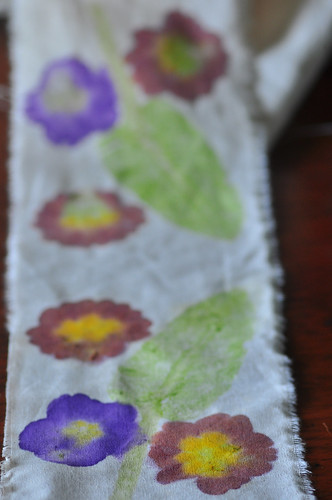
Hapa zome with dock leaves
and primula

The skill level you need to start out with this creative springboard for this is pretty basic. If you can hit things with a hammer you can create beautiful works of art. As demonstrated by a two year old and his mum.


To make hapa zome you need cotton fabric, different weights seem to all work equally well but you do get slightly different effects. The leaves and flowers that you choose make a difference to the effectiveness. Ones that are full of moisture produce the best results.
Spring crocus flowers
 By folding the cloth in half with the leaf  or petal inside you get a mirror image. Once the petal is under the cloth then it is a matter of gently pounding it with a mallet, hammer or even  smooth rock. The surface underneath will come through so find a smooth surface to work on. It seems to appeal to all ages and genders equally, I'm sure this is something to do with the cathartic nature of hitting things with hammers! 

Baby nettle leaves

Monday, 1 August 2011

Learning as much in an hour of play....

"You can discover more about a person in an hour of play than in a year of conversation." 
— 
Plato


I recently spent a wonderful 24hrs with my friend and her daughter, my goddaughter R. Now aged six, this is a child I have known since before she was born, we lived all together for a brief time when she was a baby. I met her mum met at a nature play conference and we worked together for a bit and have been friends for years. We get to meet up too rarely as we now live 250 miles apart. But the reason why I am telling you this is because in that short visit I experienced the most extraordinary hour of play.

In the course of my work I observe children at play and play alongside children a lot. Children playing together often talk and discuss the narrative of the frame in which the play is taking place "You are the dog and I am the mum and then the mum says to the baby, so you have to be the baby but I'm still the mum" sort of conversations.

As an adult invited into that play frame, or, as often happens when I take children into the woods, when I am trying to help children establish a play frame in an unfamiliar environment, a lot of talk can take place. I make observations of what is happening, the child shows me what they are doing, they ask for feedback, ask questions, try to work out the boundaries. This is all part of the containment process, of helping children maintain a play frame.

In this most extraordinary hour of play, the most extraordinary feature was that it was almost entirely silent.

My friend had to go and work for a couple of hours so I offered to look after R. There were a number of options for the morning but R said we should stay at the house and go to play in the little strip of woodland next door. We got up in the morning and my friend went to work. R did a little test of the boundaries.
 "I want to watch a programme."
 "Ha! the only way we are going to watch TV this morning is if we make the programme ourselves....Oooh actually, we COULD make a TV programme, I have my camera."
"WE could make some TV? "
So we did. R telling stories and singing for the camera, then we went out into the woods and she made a documentary on how to collect things.

As we were heading back into the house I spotted the stalks on a particular sycamore tree were really long and I pointed them out to R. This was our shared  play cue, she collected a few leaves and started winding them together, I collected a few and threaded them into a long chain. During this I offered the usual sort of statements and observations I might with a child when I was working; "You have threaded three leaves together, I think I might hang mine on this tree." Looking for ways we might extend the play frame, But I noticed that R didn't seem to need these and I stopped.


Which gave me an opportunity; I have for a while now had in mind to try and make a geometric cube from leaves. I draw much inspiration from the work of Andy Goldsworthy and as a teenager I saw one of his leafworks boxes in a gallery in the city where I lived. Ever since I had in mind to try and make one. The impetus for which came right back when I recently found one made by another land artist. I've already made one attempt which was a really useful learning process, but the thought of doing something that required so much concentration and time seemed counter intuitive when I was spending time with a lively six year old.


The level of absorption she showed made me loathe to be the one to break it. And we played in parallel she and I. Both in such a state of flow  and absorption I am still unsure how much time passed.


We spoke very little each very focused in the challenges we had set ourselves.


Occasionally delighting when something worked well.


Allow the ideas of the other to inspire us in our own play.


Stretching ourselves.


Making observations.


Until we reached a point at which the possibilities had all revealed themselves for now. R made an observation. "The dry leaves are just as good but the brown ones are two crispy."  I had made five corners of the box but run out of suitable leaves.


We collected some bits to take back to the house and moved on. The frame which had held us in a state of flow was gone. Naturally extinguished.

I felt as if in that hour of play that I had got to know R in a way that all the phone calls and letters had never revealed. I saw her deep level of ease at being outdoors in nature. I saw how dexterous and creative she is. I saw how motivated and self contained she can be. She saw me too. I explained to her how much I had enjoyed being  in the woods with a child who didn't need talking to all the time and that some children I worked with needed my help a lot more. "So is playing your job?" she asked  "You are good at playing."


Terms used in the description of the play process have been taken from The Colorado Paper by Gordon Sturrock and Perry Else 1998, P8 onwards. 

comment FB

LinkWithin

Related Posts Plugin for WordPress, Blogger...

LinkWithin

Related Posts Plugin for WordPress, Blogger...